The recent SRA leadership conference in Leicester was a dynamic and lively event. It’s no surprise that people involved in high level competitive sports were energetic and results-focused, and keen for their organisations to win! So here’s my winning formula for powerful leadership of civil society organisations.
.
.
10 days ago I attended a dynamic and lively leadership conference hosted by The Sport & Recreation Alliance in Leicester. I was there to run a large workshop for CEOs, and to participate in a plenary session, on building high-level CEO-Chair relationships.
.
The SRA covers such a breadth of organisations, from those championing world-class competition, or those promoting professional spectator sports, through to grassroots community engagement projects, as well as those representing a multitude of recreational activities. These organisations are also constituted very differently: there are charities, limited companies, social enterprises, strategic partnerships, organisations hosted by academic institutions or county councils – and various combinations of these. Many board members serve in a voluntary capacity, but a few are paid either directly or indirectly.
.
In a gathering with lots of leaders from competitive sports organisations, it’s not surprising that people were energetic, ambitious, and focused on results. Many of the delegates who asked questions from the floor, wanted to know the best and most efficient way to do things. They asked speakers to give their expert opinions about: the best way to structure an organisation; whether CEOs would be more effective if they had a place on the board; what measures to use to establish whether a board is highly effective; or what techniques to use to fast-track the development of a new CEO-Chair relationship. They were asking high level practical questions, aiming to identify the “winning formula” for their organisations.
.
I really enjoyed the challenge of these questions, so here are my 6 key ingredients of a winning formula for powerful organisational leadership which I presented in my workshop presentation to CEOs, and discussed in a subsequent plenary session with governance consultant Linda Laurance (who ran a parallel workshop for Chairs) – and voluntary sector leadership consultant Tesse Akpeki who chaired the session.
.
.
.
.
1. Understand the Systems Operating in Your Organisation
.
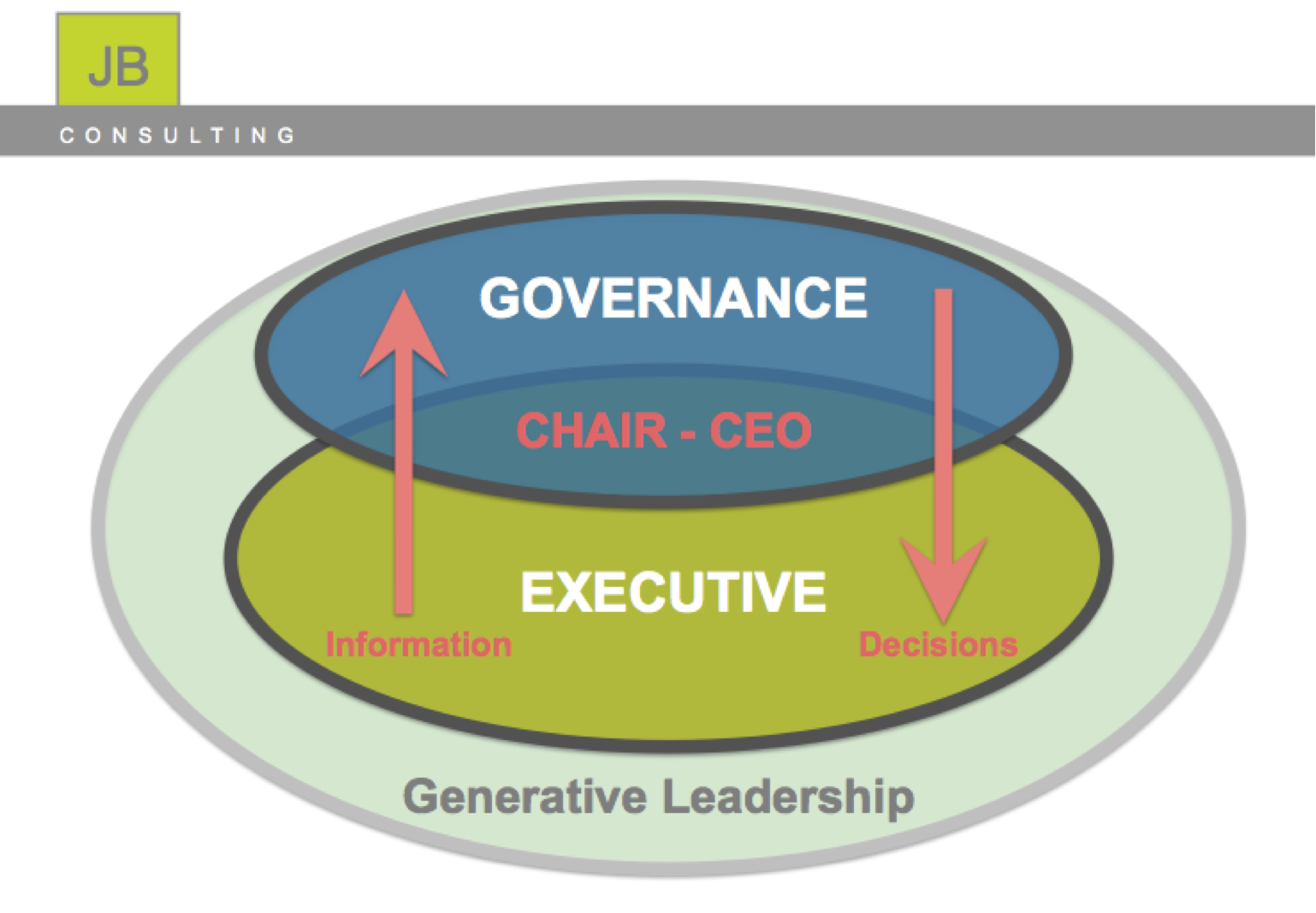
Whatever their particular differences, most of the SRA member organisations share a basic organisational structure. Each structure has 3 primary interlocking systems in common:
.
- There is an over-arching board of people responsible for Governance and safeguarding the core principles of the organisation. This is led by a Chair who provides inspiration and containment for people’s ideas.
- Underneath this board is an Executive System of personnel responsible for driving through change on behalf of the board. This is led by the CEO who also provides inspiration and containment.
- The CEO and Chair connect up these two systems, and mediate the complex boundaries between them.
.
When an organisation functions at its best, there is a flow of information upwards from the executive system, which the Board uses to inform crucial governance decisions about the future of the organisation. Once these decisions have been made, they are implemented downwards through the executive body of the organisation.
.
(Of course the organisations will be significantly more complex if they are member-led, partnerships, or hosted within larger institutions.)
.
.
2. Understand the Innate Tensions That Must Be Managed
.
This 3-system structure carries its own set of innate tensions which are likely to flare up whenever the organisation comes under pressure:
- The CEO and Chair interaction can form a bottleneck which obstructs the flow of information upwards flow of decisions downwards.
- The CEO role can be squeezed from above and below. It can feel very isolated and highly exposed.
- The Chair and Board can experience the CEO as a barrier to “real” contact with the wider organisation.
- The CEO and staff can experience the Board as a barrier to efficient and effective decision-making.
- The CEO “lives and breathes” the organisation 24/7, and can experience the Board as out of touch and removed from operational life.
.
These tensions can lead to anxiety and frustration, and can knock people out of their designated roles. (eg. board members may circumvent the Chair and CEO, and issue management instructions directly to staff. Staff may lobby board members to have the CEO’s decisions overturned. CEOs may engineer the board’s decisions.) These tensions cannot be eradicated, they can only be acknowledged and managed. High performing organisations talk about these tensions; they have the talent to quickly recognise when people are out of role, and will move swiftly to rectify this.
.
.
3. Manage The CEO-Chair Dynamic Relationally Not Technically
.
In this 3-system structure, a positive and effective CEO-Chair relationship is essential, not optional. It sets the tone for relationships in the rest of the organisation.
.
Although technically speaking the Chair line manages the CEO on behalf of the Board, the relationship cannot be treated just like a classic control-and-command line management arrangement. It has to be handled relationally on a basis of trust and broad consensus. This is because the CEO has the power to obstruct the implementation of a unilateral decision by the Board. Equally, if the CEO loses the confidence of the Board, the Chair could intervene and micro-manage the organisation.
.
Once a CEO-Chair relationship becomes hostile it is extremely difficult to repair it. And if either party opts to formalise the fight (through disciplinary, grievance, competency or equalities procedures), this becomes an end-game, and one or other party will be forced to leave the organisation.
.
.
4. Practice Generative Leadership
.
It is common for boards to focus on their fiduciary and technical responsibilities: concentrating separately on legal compliance, finances & resources, performance targets, risk management, organisational structure, business planning and strategy. While each ingredient is essential for organisational survival, just focusing on these items alone is dangerous, and focusing on them together is still insufficient for effective leadership in a C21st context.
.
For example, in the current climate of austerity, SRA members face a heady blend of cutbacks, opportunities and radical economic shifts. (The Sport England and public sector budgets have been savaged, which affects funding for civil society organisations. But many SRA agencies could benefit from The Big Society, public health budgets, wellbeing targets, the Olympics, and other international sporting events.) Each of these throws up complex leadership questions, such as:
.
- How do we provide solid leadership in a very uncertain world?
- How do we take tough decisions and still keep staff engaged?
- How do we rapidly gain high level entrepreneurial skills?
- How do we seize business opportunities and still safeguard our values?
- How do we adapt to the current government’s policies, whilst shaping a future for our organisation beyond the lifetime of this these policies?
- How do we form productive partnerships with other organisations – balancing collaboration and competition?
.
In order to do justice to these complex dilemmas, the CEO, Chair and Board need to line up their roles and practice Generative Leadership: understanding how the various fiduciary and technical responsibilities interact with each other, whilst also integrating these with the organisation’s vision and values, and holding a bigger picture of the long term external landscape.
.
.
5. Stay Tuned To The Fundamental Questions
.
The SRA membership represents such a diverse range of organisations and structures that it is impossible to advocate any one-size-fits-all optimum structure for all members agencies. Instead I think there are 5 guiding questions to be mindful of:
- What structure works best for which type of organisation, under what circumstances?
- Can we articulate the strengths and weaknesses of our particular structure – then maximise our strengths and mitigate the weaknesses?
- Are we all clear about each person’s role in the structure?
- Where we have dual roles, how will we manage our conflicts of interest?
- How will we evaluate our effectiveness? (What exactly are we evaluating?)
.
.
6. Know When To Compete And When To Collaborate
.
The strength of organisational leaders like those I met at the SRA conference is that they are ambitious and really want to succeed. Their ultimate challenge is to be able to manage their competitive instinct, so that this doesn’t jut become a default position adopted for every working relationship. They have to know when to compete and when to collaborate.
.
So there was a powerful moment in the workshop on building high-level CEO-Chair relations, when one group of CEOs acknowledged: “We have to want our Chair and Board to succeed in order for us to succeed, and for the organisation to succeed.”
.
How can the CEO and Chair line up and encourage each other to succeed? it needs to be thought of as a ‘coaching’ relationship rather than one of competitors. Together they need to build a shared understanding of the dynamic context in which the organisation operates. As another group said: “We must hold each other to account, build trust and respect, and act as critical friends.”
.
.
 consultjbarrett