Beyond The Hype Cycle – Innovating Effectively For Organisational Survival

.

With the current financial and structural upheavals across UK civil society, organisations have to be highly adaptable in order to survive. They need the capacity to develop brilliant innovations, and they have to implement these quickly and sustainably. Many organisations have the raw talent for innovation but find it tough to embed new ideas in the system. This is my framework for harnessing that talent and giving it shape – making the most of tightly stretched resources, and investing your energy where it is most effective.

I am very excited by The Gartner Hype Cycle. It is an unlikely source of inspiration for me because it’s actually a tool for assessing the maturity of new technology innovations! But I think it can also be applied to the way we understand how cultural change is driven – whether this is internal organisational innovation or wider social policy change. I’m really interested to hear what you think of this.

.
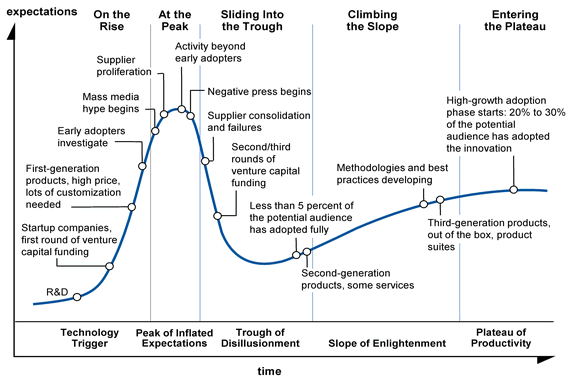
The Garner Hype Cycle Tracking Technology Innovations

Firstly, to explain the Hype Cycle in its original context as it applies to technology:

  • A new technical discovery creates buzz – a Technology Trigger.
  • It is hyped in the media to a Peak of Inflated Expectations – suggesting exciting possibilities that seem to take us into the realm of science fiction. (eg. currently it’s cloud computing that’s getting hyped.)
  • But then this new technology doesn’t live up to its elevated expectations, and instead a Trough of Disillusionment sets in. (eg. consumer-generated media seems to be going nowhere at the moment.)
  • Then a second wave of interest and enthusiasm adopts this technology and accelerates its development – there is a stable and evolving Slope of Enlightenment. (eg. app stores are becoming widely appreciated.)
  • A third wave then improves reliability and user experience, and it is accepted in everyday practice. It reaches a Plateau of Productivity. (eg. speech recognition software is now commonplace.)

I came across the Hype Cycle via my favourite new technology blogger, Digital Tonto, who makes 3 essential observations about the process of developing innovations:

  • Technology doesn’t exist in a vacuum but must interact with other ideas to become useful. “It’s when ideas and technologies combine that real value is unlocked.” (My interpretation is that technological innovation needs to fit with the social context to become a social innovation.)
  • Innovation requires two profoundly different skill-sets to take hold: one to create radical new ideas; and another to bring about mass adoption of these ideas.
  • It’s very difficult for these two strands of innovation to co-exist – the strands need to be separate to allow both to flourish, but must be sufficiently networked to enable synergies to happen between them.

Of course there are lots of practical differences between taking new technology to market, and driving cultural change, but I think the overall trends from the Hype Cycle are relevant to our thinking about change, and Digital Tonto’s essential points about technology are transportable to the cultural change process too.

The Stages Of The Gartner Hype Cycle.

.

.

.

.

.

.

.

.

.

.

.

.

This is my take on The Gartner Hype Cycle from an organisational perspective:

  • Leaders will identify a Trigger for radical change.
  • They will work with their top teams to build their vision of a ‘brave new world’ for the organisation – then announce it to the staff with a great deal of enthusiasm. This risks being a Peak of Inflated Expectations if the anticipated change is too idealistic and unrealistic about what the organisation can handle. Staff experience it as hype.
  • A few staff may ‘get it’ right away, but on the most part the proposed innovation will fail to register with the workforce. People lower down the hierarchy will struggle to engage with the idea or to appreciate its practical implications for their work. They will be reluctant to let go of ‘the way we do things round here’. The proposed changes will fall flat and run adrift in the Trough of Disillusionment.
  • Then leaders will invest a great deal of effort, pressure, engagement and persuasion to get the rest of the organisation to grasp the value of the idea. They will involve staff in more solid, practical analysis – developing a business plan, and testing the viability, applicability, risks and benefits of the proposal. Gradually staff will take ownership of it, and fit it to their way of working – it will travel up the Slope of Enlightenment as they improve its ‘usability’ and ‘debug’ working practices.
  • The benefits of the new ways of working will be demonstrated and accepted as routine practice, and the idea will reach the Plateau of Productivity.

What I would add about the Hype Cycle as it applies to cultural change, is that the process of adopting an innovative idea and assimilating it into everyday practice dilutes its original radical edge. On the one hand this reflects the success of the change programme – something new has been accepted and no longer poses a threat to staff. On the other hand it also reflects the fact that established culture ‘neutralises’ the impact of change – making it more mundane and less profound than the leader might have expected. It doesn’t conquer the peak of inflated expectations, but instead settles somewhere lower down the slopes!

In my consulting I come across pioneer leaders who feel gutted at this point when their radical change programmes don’t yield the rush of exhilaration and success that they had hoped for. Some want to move on to a different organisation to have a go at changing another system. Others want to plunge into a new change venture in the same organisation. Either way if they don’t first take stock of their mental models of change, they risk frustrating themselves unnecessarily all over again.

I think it’s essential for leaders to recalibrate their expectations and to refocus their energy where it is most effective. They need to recognise that something will inevitably be ‘lost in translation’ between original concept and working practice, and therefore that they need to work hard at connecting up the different parts of the Cycle to minimise this effect. It takes sophisticated integration to achieve sustainable change – rather than heroic solo efforts to scale the peak of inflated expectations. Leadership is about chemistry, and finding the right fit with the organisation.

You may have noticed that The Gartner Hype Cycle is similar to the Change Curve that I described in my earlier blog on How To Handle Those Really Tough Decisions In Your Organisation . While the Hype Cycle describes the mental process involved in adopting new ideas, the Change Curve describes the psychological adjustments involved in adapting to difficult changes. If you put both models together, you can identify the most appropriate strategies for supporting your staff and keeping them engaged through the different stages of organisational change.

Here’s a checklist for staying focused and making your interventions more effective:

  • For change to be compelling it has to resonate with meaning for the people you want to engage, so make sure that your innovation fits the organisational context.
  • Anticipate peaks and troughs in the change process so that they don’t throw you off course. When these occur, hold the organisation steady and provide containment for your staff’s anxieties.
  • Help your organisation to anticipate these peaks and troughs too by talking about them at the start of the process when everyone is most in alignment. Explain that differences will become more apparent, and that these may be painful and uncomfortable at times, but that the organisation will be better for the change, and you will all survive the experience.
  • If you find your ideas falling on stony ground, resist the urge to push harder at ‘hyping’ them. Step back and think about what mechanism will bridge the gap between your proposed innovations and the practical realities of those who have to implement these for you.
  • Develop the talent in your middle management teams to provide a ‘translation service’ between senior leaders and those at the coalface.
  • Encourage frontline teams to experiment with implementing your ideas – to transform these ideas into practical processes with coalface ‘usability’.
  • Encourage service users to demand more so they create a ‘pull’ to reinforce the changes that you are pushing.
  • If you want to introduce profound change, it is better to approach it as a series of initiatives – to use the cumulative effect of several waves of change so that their momentum isn’t neutralised.
  • Empower your staff to be the instigators of change, rather than just the implementers of top-down initiatives. Create separate space for the organisation to focus on generative ideas, free of the pressure to justify how those ideas will be implemented. Engender a buzz of excitement and expectation that innovation will happen.

.

This blog describes the implications of the Hype Cycle for internal organisational change. In my next blog I will pick up on the very different implications for wider social policy changes. I believe it identifies significant opportunities for civil society organisations to put themselves on the map and take advantage of the disillusionment that arises in the early days after new government policies have been hyped.

I’ve already had some great conversations about these ideas, so I hope they resonate with you too. Do please leave comments or contact me directly let me know your responses to this article.

.

.

My grateful thanks to Dr Barbara Grey, Director of Slam Partners, South London & Maudsley NHS Foundation Trust, for contributing additional ideas to this post.

.

How To Handle Those Really Tough Decisions In Your Organisation

.

So you’ve realised the need to take crisis action to bring your organisation back on track. Perhaps you’re having to implement radical changes to terms & conditions, to shake up working practices, or to introduce redundancies. You’re clear about the strategic imperative for this, you know your legal responsibilities, and your mind is fixed on a course of action. But how do you implement such tough decisions and still keep your staff engaged? The solution lies in intellectual and emotional clarity.  This is one of the essential skills of contemporary leadership. It’s difficult to get right, so here’s a structure to steer your interventions.

.

Many clients say that it can be a lonely experience leading these difficult changes.  In the current funding climate a number are feeling sorely tested. (“I didn’t take on this job to dismantle services and implement compulsory redundancies!” “Staff are so angry with me, I dread going into work at the moment.”) These leaders face a really difficult dilemma. For the sake of the survival or their organisations they know they have to act fast to implement tough crisis decisions that will have major negative consequences for their staff. But they also know that they are completely reliant on staff going that extra mile to help bring the organisation back on track. So they have to find a way to engage staff and sustain their goodwill by helping them to understand why these hard decisions are being made.Some clients admit that in the past when they faced tough choices they became detached and hard to avoid the guilty feelings that their decisions stirred up in them. “I wanted to ‘slap’ staff who become angry or distressed – couldn’t they see what a mess we were in?”  Others felt so overwhelmed by their statutory obligations that they became mechanistic (“I followed a tick-box consultation just to cover my butt!”). But these approaches made things even more difficult for the organisation. So leaders actually need to do the opposite: to remain conscious and articulate about the unhappiness that your decisions might cause people, whilst being totally clear about why these decisions are necessary. As one clinical director put it: “You have to feel the pain and do it anyway – as compassionately as possible” …mindful of the fact that it’s awful to have to deliver bad news, but even tougher to be the recipient. 


To do this you have to attend to two parallel issues simultaneously: one is to engage people in the logical rigour of the decision-making process itself; the other is to attend to the emotional impact of the decisions on individuals. If you want people to engage with the logical changes that you are introducing, you have to be in sync with their feelings. And if you want staff to manage their negative reactions to your changes, you have to present a coherent case for for the judgements that you are making.

There are two things that infuriate staff. One is being shut out from the decision-making process. More so if they could have made an important contribution, and believe they would have reached a better quality decision themselves. The other is having their emotional reactions stifled by leaders who put a Pollyanna spin on their unhappiness.  (“I’m afraid your post will be made redundant, but at least that solves your work-life balance, eh?!”) So how do you attend to the decision-making and emotional dimensions of your leadership role? Let’s take each dimension in turn.
.
The Decision-Chain
When presenting a difficult issue to your staff, you may be very clear in your own mind about why your decision is necessary, but it can really help to walk them through a structure such as the 6 elements in the decision chain below. Each element needs to be tested separately in sequence, to ensure that people have really understood the case that you are arguing.


1.) Dilemma – Have we articulated and refined the problem? What is the dilemma that we have to solve? (eg. We are heading for a serious overspend that threatens the solvency of the organisation. We have to balance the budget now.)
.
2.) Data – What are all the relevant facts? Have we captured all the evidence available? (eg. There is no obvious funding to bail us out this year. Staffing costs make up 80% of our operational budget.)
.
3.) Options – What options are available to the organisation? Have we explored all realistic alternatives? (eg. We could merge, share back-office functions, or share our CEO post.)
.
4.) Impact – What are the personal and organisational implications of each option? Do we fully understand the risk in each case? How can we mitigate against negative effects? (eg. What packages of support can we put in place to support staff at risk of redundancy? How can we motivate those staff who remain?)
.
5.) Solution – Have we distilled this information thoroughly? What conclusion have we reached about the best way to resolve our dilemma? (eg. We have no choice but to cut our staff posts by 25%.)
.
6.) Action – What is the course of action for implementing our solution?
.In the pressure of a crisis meeting when tensions are running high, leaders can be thrown off course by the intensity of feeling in staff who are fearful for their jobs. Individual staff may be fired up by different issues in different segments of the decision-chain. One may point out additional options (“We don’t have to cut posts, we could all agree to working fewer hours.”) while another will question the original dilemma  (“We don’t have to balance the budget, we can use up our reserves.”) and another will raise new concerns about the impact (“If we cut posts now we won’t have the capacity to to deliver the services we are contracted to supply. The council will terminate our contract, and that will finish off the organisation.”). It really helps to lead people back through the structure, so that each contribution can be put in context. 

Remember that it isn’t a democratic process, and many staff may not agree with your conclusions, but this is an opportunity to listen to alternative perspectives and be really clear in your own mind about your decisions. The most important thing is that people understand the dilemma that the organisation faces, and get to walk in your shoes – so rather than get yourself boxed into a corner by a barrage of questions from staff, remember to keep asking questions yourself, link these to each stage in the decision chain, and really listen to the answers that staff give.

Many leaders are very familiar with principles of employee engagement, and place great value on staff contributions in business planning and scenario forecasting. But even when staff are kept in the loop, the reality of crisis decisions can still come as a shock. The tougher the decision that has to be taken, the more likely it is to rest on your shoulders as a top-down process without a lot of room for manoeuvre. So it is essential to be clear about what issues are up for debate, and what elements are fixed in stone – staff are infuriated by token consultation on issues that have long been decided. Even in severe consultations there should be scope for staff input into impact assessments and mitigation of negative effects, and in the action planning stages.


.
Emotional Life
.


.
Many people will recognise this diagram – charting people’s emotional reactions to difficult changes – but not everyone fully understands the implications of the curve for change leadership: People experience four different emotional stages when change is thrust upon them:

1.) Shock – in which they feel numb and stunned, and have very limited ability to think clearly.  They might deny the implications of the news, or even weird feelings of euphoria.
.
2.) Emotional turbulence – in which they are consumed by sorrow, anger or guilt. They may have emotional outbursts, or might withdraw and need time on their own to make sense of their feelings.
.
3.) Depression – in which they churn over the implications of the changes, and start to make sense of what is happening. They will feel emotionally flat, demotivated and resigned, and this churning will sap a great deal of emotional energy from them, so it is likely that their productivity will be low.
.
4.) Gradual acceptance – in which they start to re-enage, come to terms with the consequences of the changes, integrate these into their everyday context, and look ahead more optimistically.
.

What are the implications of this for leaders introducing difficult changes? One significant feature is that you are likely to be ahead of your staff on the curve. Chances are you’ve had the shock of realising that you have to take serious action, have run the gamut of upsetting emotions, and are galvanising yourself into action by introducing these decisions. This can make it more difficult to empathise with people who are still in a state of shock, or feeling emotionally wobbly.  People experience the transition curve at different rates, so different staff will be at different stages  – and their progress is never as neat as the diagram suggests, so keep an eye on how people are and adapt your interventions accordingly.

1.) When in shock, people won’t be able to take in much information that you give them, or to grasp the full logic of your decision-chain, so explain the headline features and provide clear written information for when they are in a calmer frame of mind. Acknowledge that people may be in shock, explain the stages that you will be taking for consultation and implementation, and reiterate that there will be future opportunities for discussion. Show that you have considered the impact of your decision by outlining what support you would like to make available. Time your input to minimise disruption to the working day, and to make sure that staff have time to get over the initial shock before they head home. Don’t put a “Pollyanna” spin on things by pretending that the circumstances are good, but do reiterate the positive bottom line that you are after (“If we can implement this redundancy programme now, the organisation will be more robust for the future.”).2.) When in a state of emotional turbulence, people will need help to recognise and name their feelings. Ask them how they are, and what support they need. Articulate your feelings (“I feel really uncomfortable having to break this bad news to you, cause I imagine it must make you feel very frustrated.”)  Walk in their shoes and recognise what they are going through. You are their most likely target for hostile feelings, so be prepared for that, and build in time to debrief afterwards.  Be strong and containing to model that you are capable of holding the organisation together through this difficult period. Carefully acknowledge the emotions you are noticing (“You sound angry with me at the moment, which is understandable given what you’ve just been told.”) and resist the urge to attack back. At the same time, you don’t have to endure abuse, so if any meeting gets out of hand, end it and schedule a follow up event – you need to model the fact that there are limits and that discussions have to be dignified. 

3.) Staff will reach a depressive stage in which they feel they have no choice but to accept the changes, so factor in a period of demotivation when productivity will drop.  It’s easy to be sucked into their sense of hopelessness at this point, which might churn up lots of helpless feelings in you. (“It felt like wading through treacle!”) The instinct is to go into “rescuer” mode and try to find practical solutions to their problems, when in reality these will be rejected because staff are really seeking affirmation for their feelings of resentment. So acknowledge that it is difficult for them, make an effort to understand what people are finding most difficult, and keep asking them to identify what would make their tasks more manageable. Notice those things that individuals are most interested in, and really focus on developing these. As they “churn” they will be incorporating the changes, so this is an opportunity to make some adaptations and to flesh out the practicalities of how to the implement the plan.


4.) As staff gradually accept the changes, the mood will become more positive. This is the time to pick up the pace, become more challenging, and really stretch them with questions about how they see themselves implementing their part in the programme. These are the activities that leaders are most familiar with – that some leaders try to implement prematurely, at the point when staff are still in shock and not ready to engage. If you can hold fire until staff are showing signs of acceptance, you stand greater chance of succeeding.  Again, remember to acknowledge the fact that staff are more positive, and be appreciative of their progress.
.

When people are confronted by painful scenarios it tends to trigger “paranoid” anxieties, so it’s essential to emphasise the values and principles underpinning your decisions, and to act with integrity throughout. Keep the overall focus of your decisions on your organisational mission and your service users, but focus your implementation on the needs of your staff – give them permission to look after themselves, and help them to direct their energies at what they can control. Encourage them to have a “Plan B” in mind for their worst case scenarios – so that they can set aside these anxieties for the time being. (“We’ve done everything we can for now, and we’re not going to let ourselves worry about it unless it becomes a reality.”). The bottom line with difficult change is that feelings need to be understood, named and appreciated rather than bottled up. It’s once these can be fully acknowledged that your staff will begin to reconnect with their creativity and passion for the organisation.
.
.

Forging Partnerships Across The Fault Lines

Partnerships may be the key to realising The Big Society but they need sophisticated handling to work effectively across the fault-lines. Effective partners engage tactically not idealistically.


Partnership working is being heralded as The BIG ANSWER to The Big Society, Localisation, and on a tumultuous public spending review. What’s not to like? It is true, partnerships will be an essential lever of The Big Society, but not in the idealised form that politicians would have us believe. Partnerships have innate adversarial tensions built into their relationships, and these can only be worked with – they cannot be eradicated.

To make the most of partnerships, the partnership leaders need to manage these tensions – as far as possible lining up member organisations behind a vision of what the partnership might be, whilst helping members to work with the frustrations and contradictions where it falls short of these aspirations. Equally, participant organisations need to understand that partnerships are a shifting coalition of interests, complex and messy, with unpredictable consequences. Partners need to engage tactically not idealistically, mindful of the pressures on other member bodies, engaging in satisfying alliances for a finite time within the current constraints, where they can see a clear advantage.

I guess the current ConLibDem Coalition Government is a perfect example of this  – The Cameron-Clegg pairing is an arranged marriage with possibilities and potential and risks and dangers. How can they make the most of what has been thrust upon them? If they misunderstand what is possible and presume to be in love, they will burn up their energy by flirting, seducing, squabbling and divorcing – missing the opportunity to have a significant workable relationship! That partnership will last (only) as long as each party can co-opt the opposition and has sufficient goodwill to involve each other in co-creating solutions. It will break up when the partners run out of goodwill or when their differences overwhelm their commonality.

.

Learning From Local Strategic Partnerships

Although partnerships take many forms, I think the experience of Local Strategic Partnerships provides a particularly rich picture of the fault-lines that cut across effective working. Tensions emerge most clearly after Government spending allocations, and Council or PCT tendering rounds. These tend to bring into sharp relief the painful reality that there isn’t economic parity between members of partnerships, and partnerships are ultimately not democratic. Here are a few examples:

  • Although they don’t participate directly in partnerships, Central Government departments can have major impacts on these groups. They tend to grapple with espoused values of localisation vs their need to influence what happens regionally or risk getting slated in the tabloids or getting it in the neck from the electorate. Their main official tools of control are blunt instruments: funding, targets and inspections.
  • Central Government sometimes makes partnerships a criterion for funding local statutory bodies – thus confusing process (ie. “create a partnership”) with intended outcomes (eg. “reduce violent crime by 10%”). These statutory bodies rush to create partnerships in order to meet funding criteria, and the groups then struggle with disingenuous motives and unclear outcomes.
  • Local Statutory Bodies (PCTs, local councils) wrestle with the tension between democratising their decision-making, whilst feeling burdened by their safety liabilities, procurement legislation, and accountability to central government. They give out confusing messages to partnership members about their sphere of influence.
  • Government Departments can find themselves concerned to leverage positive results more quickly (eg. In time for elections), and allocate new funding that has to be spent rapidly on high profile initiatives. Local statutory bodies then struggle with the tension between taking rapid autocratic decisions to allocate funding within the timescale, vs losing out on the funding.
  • Local Statutory Organisations do not behave as unitary entities – different parts of each organisation pull in different directions and take contradictory decisions. (eg. Adult Services increases funding to a carers’ charity while Central Services evicts the charity from the council’s low-rental premises.) Individual members of staff representing these statutory organisations get it in the neck from partner organisations and can feel very put-upon.
  • Smaller Provider / Community Organisations wrestle with the tension between maintaining a presence in cumbersome LSP meeting structures where the sources of funding are, whilst trying to find capacity to deliver essential services in the community.
  • Smaller organisations feel compelled to tender for service contracts in order to earn income to survive, which can distort their original service mission and values.
  • Central and Local Government struggle to consult directly with service users without the mediation of local community groups. They both believe that they have the mandate of their electorate.
  • Local Community Organisations fire fight daily to resolve the crises of their users. They believe they have the mandate of the disenfranchised, and that they represent the “true” voice of service users.
  • If the partnership focuses on the details of the personal experiences of individual service users, then senior Statutory members disengage, stop attending, and the Partnership loses its “bite”. If the partnership focuses on very corporate matters, then local Community Groups and Service Users become alienated and the Partnership loses it’s “user-credibility”.

Future partnerships may take different forms, and may have different fault lines, but the underlying theme remains:

For a partnership to be effective, larger participant organisations have to manage the tensions between commissioning and providing services, and service agencies need to strike a balance between collaboration and competition. The successful players in a partnership are the organisations that recognise these dynamics and decide to engage tactically – rather than those that attempt to be idealistic and all-encompassing.

The successful partnership is able to see the relationships for what they are, rather than believing the espoused rhetoric of democracy. If these tensions are not managed effectively, conflict erupts, all institutions retreat, and everybody loses out – especially service users.

If the partnership can acknowledge the contradictions, and work with them in a measured and contained way, greater trust will evolve over time. Decision making processes will gradually become more consultative if partners demonstrate mutual understanding and learn together.

.

.

Is The Voluntary Sector The Natural Home Of Liberating Leadership?

What charities can learn about leadership from their service users’ experiences.

Last week I went to an inspiring seminar at CASS Business School, hosted by the Centre for Charity Effectiveness (www.cass.city.ac.uk/cce/newsevents/ CharityTalks)  Jon Barrick, CEO of The Stroke Association (www.stroke.org.uk), gave a passionate account of how he had achieved a remarkable turn-around in the organisation by modelling “servant leadership”. His approach squared well with my human relations thinking: that the duty of leaders is to engage staff and enable them to take up the full positive authority of their roles.

Andrew Forrest, Visiting Fellow, then gave a wonderful accessible academic presentation: he put servant leadership into the wider context of other recent leadership models. Andrew suggests that current leadership theory has moved on from the previous framework of “Transformational Leadership”.  A new wave of leadership writing might be grouped under the banner of “Liberating leadership”, to include ideas about:

  • Servant Leadership* – Earn the right to lead.
  • Values-Based Leadership – Encourage ownership of core values, and people will take intelligent decisions based on these.
  • Emotional Intelligence – Develop capacity to experience, recognise and think about feelings, in order to attend to these in the workplace.
  • Complexity – Work with the fluid, dynamic nature of organisational systems.
  • Authenticity – Disclose more of yourself and be seen as a fully rounded individual.
  • Followership – Attend to followers and their needs – they are more important to leaders than vice versa.
  • Storytelling – Make conversations real, share knowledge, reinforce the organisational mission.

The common element of Liberating Leadership is a values-driven, transparent, human (“authentic”) leadership that relinquishes control through extensive delegation and consultation in a flat organisational structure. There is a high degree of direct contact between the leaders and followers – with the leader attentive to the best ways of removing obstacles so as to enable people to excel in their work roles. Liberating leadership aims to unlock talent, share knowledge, and reward learning.

It was exciting to see this presentation in a voluntary sector context, because I think that at its best the voluntary sector is the natural home of liberating leadership. The sector already champions a form of liberating leadership in its delivery of services to its beneficiaries – it places service users at the heart of the organisational experience. Many charities also adopt aspects of liberating leadership in their radical nurturing of volunteers.

The challenge for voluntary organisations is to transplant this existing framework of user and volunteer empowerment, and to extend it into their relationships with staff. If organisational leaders want their staff to go that extra mile – want staff to strive to bring out the best in the service users – then leaders have to model this same approach themselves by bringing out the best in their staff.

The Best and Worst of Service User Experiences

I say that at its best the voluntary sector is the natural home of Liberating Leadership, because, understandably, at its worst, circumstances conspire to make the sector the most unlikely home of such leadership. When voluntary organisations grapple with hand-to-mouth funding, uncertain futures, and client trauma, this can foster a deeply insecure culture in which staff are pressured to stretch themselves beyond sustainable limits, and think they have to sacrifice their wellbeing for the organisational cause. (Similar dynamics happen in over-stretched public sector services too, where leadership can get very bullish.)

There is a deeper reason why I argue so forcefully for Liberating Leadership in the voluntary (and public) sectors:  One of the most fascinating phenomena that occurs when care organisations come under this sort of extreme pressure, is that the staff and volunteers tend to mirror the distressed behaviours of their service users.

For example, in a stressed mental health service, each different team seems to exhibit its distinct forms of distressed behaviour when confronted by change: old age psychiatry seems more confused and forgetful; child and adolescent units can get more rebellious and stroppy; and forensic teams can be full of aggression and hostility. In other sectors I’ve seen senior managers in schools squabble with each other about who is in or out of the social “gang”, behaving as if they were having a playground spat; and I’ve experienced drug and alcohol projects whose working practices are as chaotic as their clients’ lifestyles!

It is essential to understand this extraordinary phenomenon when managing workplace conflict, because it explains why ordinary individuals who are generous and sophisticated with their service users, can sometimes be unexpectedly hostile and immature with their colleagues. If leaders can help staff to recognise that this behaviour may be connected to service users’ distress, they can break the patterns and introduce a healthier culture. The key message here is that the behaviour is understandable, but it is not helpful. Staff need help from their leaders to think about how they will change it for the better.

The Clues to Liberating Leadership Are There

I think Liberating Leadership provides the framework for helping staff to make these changes. I also think that charities need to look to their empowering service user models for inspiration about how to lead their staff effectively. If charities have already designed brilliant services to help their users resolve their crises, then these services will provide a clue about what help staff might need to manage their distress.

For example I worked with a women’s refuge that provided a remarkably safe, containing service to its users, but at great personal cost to the employees: staff could be shockingly aggressive and were deeply untrusting of each other. I asked staff whether their hostile behaviour might mirror the experiences of service users, and the idea seemed to make sense to them. After that whenever tempers flared the CEO became remarkably effective at drawing attention to the “domestic violence” taking place in the office, which tended to nip the aggression in the bud very neatly. She did this with a lightness of touch, and helped staff to devise their “security procedures” for handling interpersonal conflict with colleagues. She also encouraged staff to take up their  autonomy in their roles, based on the organisational values of human dignity and independent choice – values that applied as much to the staff as the service users.

___

I found this book really helpful for explaining organisational “mirroring”, though it’s a serious read!:

The Unconscious at Work – individual and organisational stress in the human services, Obholzer and Zagier Roberts (eds), Routledge, London (1994)

Otherwise get in touch – I’m always happy to chat through other interesting books.

___

* I’ve adapted these definitions – they may not reflect AF’s descriptions.

The Stargazing Club

How a £300 telescope made a big difference in helping patients with insomnia.

One of the most touching organisational changes that I was a part of occurred through the work I was doing with a consulting team, helping to turn around a failing mental health service that had a long-standing history of patient bullying.

One of the many signs of trouble in the organisation, was that the ward staff reported a severe problem with “patient insomnia”. They blamed sleepless patients for causing terrible problems with safety, sanitation and building security. Staff moaned about their endless battles to “force patients to go to bed at the designated time”, and they carried out harsh interventions on the wards. There was also bitter conflict between staff and managers as they fought with each other about the most effective ways to control patients’ sleep patterns.

The consulting team worked intensively with the whole mental health staff group to create an environment where people could be more curious and collaborative in thinking about their work. We pressed staff with key questions: Who is this service for? What is its purpose? What core values should guide what you do? What are your individual roles in delivering these?

A symbolic turning point came when one of the ward nurses requested £300 to buy a night telescope, and started a Stargazing Club for patients. This broke the deadlock: patients and staff no longer had to battle over the night schedule. instead there was an initial rush of patients joining the club, and then gradually as the weeks passed an increasing number skipped stargazing to catch up on their sleep. A few patients with enduring insomnia continued to make use of the club to relax and make the most of their waking hours.

What’s great about the Stargazing story is that it is a perfect illustration of systems thinking:

  • When we tackle complex organisational problems, we often tie ourselves in knots by formulating the problem incorrectly. We tend to mix up the symptoms, the diagnosis, and the solution we want to achieve.  So staff diagnosed their problem inappropriately as “disobedient patients refusing to go to sleep”.
  • The “solution” we pursue is often part of the problem – it often makes matters worse. The nurses’ ward regime just hacked off patients and kept them awake.
  • There is often a paradox built into the core of our “solution”. Anyone who has experienced insomnia knows it is impossible to force people to go to sleep!
  • The intervention often produces the effects that we are looking for. The ward regime set rules that were impossible for patients to stick to – it provoked patients to break the rules.
  • If our solution doesn’t work, we tend to slog away doing the same thing even harder. Staff failed to get patients to go to sleep, but they kept up their crusade anyway.

So…

  • If a solution isn’t working it is far more helpful to stop and try something different. Past failures should give us a clue about what not to do.
  • We need to go back to basics to check that we have formulated the dilemma correctly. Have we differentiated the symptoms and tested our diagnosis before identifying a viable solution?
  • The solution comes from letting go of what we think “should” happen. The nurse stopped treating patients as the problem – as disobedient people who “ought” to go to sleep.
  • We need to examine how things currently are, by asking more “what” questions. What would support patients to make good use of their waking hours? What would relax people so they can fall asleep when they are tired?
  • We need to break the cycle, not go head-to-head with a problem. Ask contradictory questions: “What’s so important about patients going to bed at the designated time? What about giving patients the opportunity to stay awake?”
  • Solutions often appear to be illogical: keeping people awake to manage insomnia!

The Stargazing Club is that it’s a classic example of how clients are able to find much more effective solutions to their problems than anything that we consultants could come up with. What we can do best is create a safe context where clients can think together, and a clear framework that enables clients to see their organisations in an entirely different light.

The best advocate of systems thinking was Paul Watzlawick. He wrote umpteen books, but my favourite introduction to his ideas is: The Situation is Hopeless but not Serious – the pursuit of unhappiness. Norton books, London (1983)