How Do Some Voluntary Organisations Still Thrive Despite Chaotic Government Policies?

.

It’s just over a year since the Coalition Government took office, and already its impact on civil society is immense. The government’s programme of spending cuts is biting hard. Its key public policies appear poorly conceived and are causing a great deal of confusion. Many voluntary sector organisations in particular are reeling from funding losses, whilst also feeling suspicious of the intentions behind new government policy. As a result many are uncertain about strategies for organisational sustainability, and concerned about how best to maintain support for service users. 

It is undeniably tough, and there are no easy solutions, though occasionally unexpected opportunities crop up when new government policy starts to go pear shaped!  It is worth understanding the dynamics of policy development in order to guard against the risks and take advantage of any relevant opportunities that occur. To do so you need to be very clear about the tactics you are prepared to adopt, and how these relate to your organisational strategy and core values.

.

.

These ideas really hit home to me when I thought about my decade of working in the HIV sector, from the early days of the epidemic. The sector achieved one of the most significant social transformations of the late 20th century, despite a similar economic depression, and the tough public sector reforms being introduced at the time.

Some of the tactics are widely know: that highly articulate people with HIV told compelling personal stories; communities lobbied on human rights; many people became expert in medical matters; and the sector pointed out how current services failed people affected by the virus. 

One smaller contribution that is less well know is that a number of HIV leaders were concerned that the public sector reforms would dismantle the progress that had been made in developing HIV services. They took a smart gamble and decide to engage with the changes – offering to pilot the NHS & Community Care Act reforms across London HIV services. As an HIV sector colleague put it at the time, “You have to go surf the latest policy waves or they will crush you!”

This put HIV squarely on the commissioning map, and gave HIV leaders a new technical advantage – they developed commissioning expertise that was valuable to their public sector organisations, so they had to be listened to. Similarly, leaders of London HIV provider services formed a consortium, developed supplier expertise, and ultimately managed complex service mergers when the funding landscape changed. Several HIV leaders went on to hold influential positions in civil society, and “mainstreamed” HIV as an issue.

Many of the tactics from that painful era can be adapted for these current turbulent financial times. 


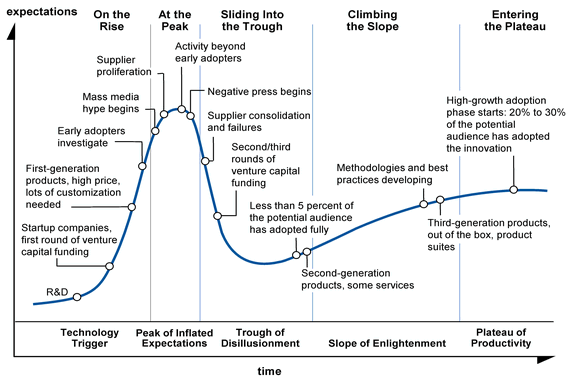
To tease out the implications, I’d like to go back to the Gartner Hype Cycle, which I introduced in my previous blog about internal organisational change. This time I’d like to use it as a framework to think about the way public social policy changes are driven by central government:

  • Our governments have an impossible task. To win elections they campaign frantically, hyping themselves senseless with catchy new social policy Triggers like The Big Society and Localism, as well as a few rehashed versions of old policies like reform of the NHS.
  • Once elected, they come to power on a Peak of Inflated Expectations, and have to bust a gut to implement their policies within the 4 year election cycle if they want to be returned to office. Which means they ignore everything that is known about how to implement change successfully. Instead they force top-down changes, way too quickly, without consultation, causing deep resentment in the workforce. Just like the current outrage at NHS reforms.
  • This is when government policy gets severely criticised, civil society organisations try to obstruct it, and it sinks into the Trough of Disillusionment. It is a period of utter confusion and discontinuity when essential batons are dropped.
  • Then governments change gear, ratchet up the pressure, and try to force through their agenda. At this point governments need pioneer projects that show how the policy can work in practice. Through these pilot projects the contradictions in the policy are ironed out, and as it becomes more viable it is taken up the Slope of Enlightenment.
  • Gradually a version of the policy becomes accepted as the norm and is integrated into everyday practice on the Plateau of Productivity

.

If your organisation is financially secure, your service users are respected in the ‘mainstream’, and you aren’t concerned about how new policy will be interpreted in your sector, then there is little point in getting swept up in the turbulence of the Hype Cycle – it is better to hold fast to your long term organisational strategy. But if you aren’t so lucky, here’s how you can work with the different stages in the cycle:

  • Policy Trigger: If you are aware of a deficit in social policy relating to your organizational mission, be proactive about setting the agenda, and put forward a compelling case for a new policy.
  •  Peak of Inflated Expectations: At the point at which a policy is being hyped and getting a lot of attention, it’s possible to ‘piggy-back’ the hype and to raise the profile of your organizational mission.  If your beneficiaries are likely to be disadvantaged by a new policy, this is a good time to challenge it.
  •  Trough of Despair: When a policy is heading for the doldrums, this is an opportunity to gain greater influence by developing expertise in the issue. Be able to articulate what does and what doesn’t work about the policy, relate this to your organizational mission, and show how your organization can provide solutions to the shortcomings.
  •  Slope of Enlightenment: This change of gear is the most volatile tipping point – it probably presents the most opportunities and the greatest threats. This is the stage where policies have to be seen to be viable, so it may offer the best opportunity to secure special funding if you can showcase innovative services that pilot the policy. You’ll need to demonstrate that how the policies can be operational.
  •  Plateau of Productivity: Here is where the regular service contracts are likely to sit, for policies that are taking hold and becoming normalized. This best suits organizations that are geared up for tendering, who can frame their service activity in the policy jargon of the moment.

 When engaging with these stages it’s worth remembering that it’s difficult to alter the political ideology underpinning a policy, but possible to influence the way in which it is implemented.  

if you are concerned about being compromised by its ideological motives, it may be some consolation to know that this difficult process of taking a new policy all the way through the Hype Cycle – and getting it assimilated into everyday working practice – probably normalises it, and  dilutes some of its original radical ambitions. Still, you need to keep reminding yourself of your organisation’s core values and principles, and the restrictions on charities carrying out political activities. 

.

The main reason why governments make such a hash of implementing their policies – and hence how opportunities arise for civil society organizations – is because politicians don’t wield as much direct power as they would like to. They are at one removed from the institutions that they have to change, so they only have blunt instruments to engineer the results that they are after.

1.) Firstly, governments offer financial incentives for specified performance targets. But this takes time to have an impact, and it involves a trade-off: cash-hungry local public services will take the funds but ‘interpret’ the government’s policy agenda more loosely in order to serve local priorities. These local bodies will also commission the voluntary sector to deliver some of these targets – which gives voluntary agencies some room to do a similar trade off: juggling the government policy targets with their own organizational ambitions, service standards, and social ethos. So it really pays for voluntary organizations to be savvy about tendering and contracting.

2.) As we are witnessing at the moment, governments make changes by cutting budgets to rival programmesThis burns up resources, disrupts services, and is carried out too quickly to catch the learning from services that are forced to close. Which makes it essential for civil society organisations to embed their own learning, and to be ready to reframe the successful work that they do in the new rhetoric of the moment. There may be opportunities for voluntary organisations to exploit their independence and to take on controversial programmes that public services have to distance themselves from (as the HIV sector demonstrated with its positive safer sex campaigns).

3.) Governments also resort to restructuring the public sector – often as a tactic to avoid head-on conflict with powerful groups such as doctors. Which means that the restructuring has little strategic logic and limited effectiveness (and is bound to be rehashed again in future). It also means that there is a churn in post-holders which makes it essential for voluntary sector leaders to refresh their networks and identify new allies in the system. One of the fortunate paradoxes is that voluntary organisations may be at the bottom of the economic food chain in civil society, but smart voluntary sector leaders are able to cut through the hierarchies of the public sector and get access to senior movers-and-shakers – sometimes more successfully than people within those organisations.*

4.) Newly elected governments rush to ‘carpet-bomb’ parliament with new policies – presumably to overwhelm the opposition – which can be very confusing. Clearly it is essential to be on the ball and on top of key policies that will have most impact on your area of work.

5.) Given that successive governments have torn up the rule book on effective change leadership, it’s no surprise that they find themselves careering towards their next election with inadequate results to show for their efforts. So they frantically turf new money at quick high-profile schemes to convince the electorate that their policies are working. It can really help to be prepared for these spending sprees, by having a viable funding proposal lined up – with some high profile quick-wins built into the programme.

6.) And of course when a new election comes around, politicians feel compelled to bury policies that aren’t working, and to then trigger a new set of policies for the campaign trail – so the hype cycle continues! It’s essential to line up with the wider issues and that have a sustainable future (eg. the ageing population, climate change and energy security, personal debt and poverty.) 

7.) But it is significant that some of the programmes that have taken hold most effectively are those projects that are adapted from one government to the next. So Thatcher’s internal markets became Blair’s ‘Third Way’, and Labour reaped the rewards of Major’s National Lottery. So it’s worth being mindful of the underlying trends that are likely to be sustained beyond the lifetime of the present parliament.

.

.

Of course the Hype Cycle is just a schematic representation – real life is a lot more messy – but the key message it conveys is that there will always be a frustrating hiatus between the development of high level policy, and its practical implementation. As long as the key government players want a floundering policy to succeed, there could be opportunities out there in the midst of the confusion. 

.

Here are some pointers specifically for voluntary organisations:

.

  • Poorly developed policies can leave organizations feeling thwarted, so it is essential as a leader to remind yourself of the expertise you already have in your organization. eg. Big Society rhetoric sounds baffling, when it is really just a new spin on old community development – which the voluntary sector has always done best.
  • Don’t assume that you have to press the government for clarity on a hazy policy – you risk getting a restrictive answer. It may be more powerful to exploit the ambiguity, or to shape the agenda by defining the policy on your terms. (Again, the Big Society is a case in point.)
  • Remember that politicians in the same party aren’t homogenous – find allies who understand your offer and beware those who may want to sabotage your work to undermine their party colleagues.
  • Put a compelling case for your mission. Know your community intimately, build your dialogue with your service users, and make sure you know your market inside out. Build a narrative around this and seek out a network of story tellers who can bring it to life.
  •  Find different points of entry in public services  – whether through service users, frontline staff, executive leaders, or elected councillors. Be clear about how your work can help them to meet their objectives. Build a strong evidence base for the effectiveness of your work to support this.
  • Know your organisation’s strategy and values, hold the balance between your core purpose and new funding opportunities – and protect against mission drift.
  •  Avoid insularity at all costs. Cuts, restructuring, redundancy, lack of capacity for long term planning all contribute to isolationism. So guarantee to schedule an horizon scanning discussion for your SMT at least every month – and do it!
  •  Ensure that your business model, systems and personnel structure provide as much flexibility as possible to be able to take advantage of the constantly shifting landscape.
  • Keep the primary focus on meeting the needs of your service users, not the needs of your organization. As the HIV sector has demonstrated, organisations are time-limited, funding cycles end, and service users’ needs change, so be proactive and recognise when it’s time to change, partner up, merge or move on with dignity. But always ensure that the learning and insights are captured.

.

__________________

.

My grateful thanks to: Graham Fisher, Chief Executive of Toynbee Hall, Kate Hinds, and to Jim Pett for contributing their ideas.

* Thanks to Dr Jill Mordaunt for pointing this out. 

.

.
Beyond The Hype Cycle – Innovating Effectively For Organisational Survival

.

With the current financial and structural upheavals across UK civil society, organisations have to be highly adaptable in order to survive. They need the capacity to develop brilliant innovations, and they have to implement these quickly and sustainably. Many organisations have the raw talent for innovation but find it tough to embed new ideas in the system. This is my framework for harnessing that talent and giving it shape – making the most of tightly stretched resources, and investing your energy where it is most effective.

I am very excited by The Gartner Hype Cycle. It is an unlikely source of inspiration for me because it’s actually a tool for assessing the maturity of new technology innovations! But I think it can also be applied to the way we understand how cultural change is driven – whether this is internal organisational innovation or wider social policy change. I’m really interested to hear what you think of this.

.

The Garner Hype Cycle Tracking Technology Innovations

Firstly, to explain the Hype Cycle in its original context as it applies to technology:

  • A new technical discovery creates buzz – a Technology Trigger.
  • It is hyped in the media to a Peak of Inflated Expectations – suggesting exciting possibilities that seem to take us into the realm of science fiction. (eg. currently it’s cloud computing that’s getting hyped.)
  • But then this new technology doesn’t live up to its elevated expectations, and instead a Trough of Disillusionment sets in. (eg. consumer-generated media seems to be going nowhere at the moment.)
  • Then a second wave of interest and enthusiasm adopts this technology and accelerates its development – there is a stable and evolving Slope of Enlightenment. (eg. app stores are becoming widely appreciated.)
  • A third wave then improves reliability and user experience, and it is accepted in everyday practice. It reaches a Plateau of Productivity. (eg. speech recognition software is now commonplace.)

I came across the Hype Cycle via my favourite new technology blogger, Digital Tonto, who makes 3 essential observations about the process of developing innovations:

  • Technology doesn’t exist in a vacuum but must interact with other ideas to become useful. “It’s when ideas and technologies combine that real value is unlocked.” (My interpretation is that technological innovation needs to fit with the social context to become a social innovation.)
  • Innovation requires two profoundly different skill-sets to take hold: one to create radical new ideas; and another to bring about mass adoption of these ideas.
  • It’s very difficult for these two strands of innovation to co-exist – the strands need to be separate to allow both to flourish, but must be sufficiently networked to enable synergies to happen between them.

Of course there are lots of practical differences between taking new technology to market, and driving cultural change, but I think the overall trends from the Hype Cycle are relevant to our thinking about change, and Digital Tonto’s essential points about technology are transportable to the cultural change process too.

The Stages Of The Gartner Hype Cycle.

.

.

.

.

.

.

.

.

.

.

.

.

This is my take on The Gartner Hype Cycle from an organisational perspective:

  • Leaders will identify a Trigger for radical change.
  • They will work with their top teams to build their vision of a ‘brave new world’ for the organisation – then announce it to the staff with a great deal of enthusiasm. This risks being a Peak of Inflated Expectations if the anticipated change is too idealistic and unrealistic about what the organisation can handle. Staff experience it as hype.
  • A few staff may ‘get it’ right away, but on the most part the proposed innovation will fail to register with the workforce. People lower down the hierarchy will struggle to engage with the idea or to appreciate its practical implications for their work. They will be reluctant to let go of ‘the way we do things round here’. The proposed changes will fall flat and run adrift in the Trough of Disillusionment.
  • Then leaders will invest a great deal of effort, pressure, engagement and persuasion to get the rest of the organisation to grasp the value of the idea. They will involve staff in more solid, practical analysis – developing a business plan, and testing the viability, applicability, risks and benefits of the proposal. Gradually staff will take ownership of it, and fit it to their way of working – it will travel up the Slope of Enlightenment as they improve its ‘usability’ and ‘debug’ working practices.
  • The benefits of the new ways of working will be demonstrated and accepted as routine practice, and the idea will reach the Plateau of Productivity.

What I would add about the Hype Cycle as it applies to cultural change, is that the process of adopting an innovative idea and assimilating it into everyday practice dilutes its original radical edge. On the one hand this reflects the success of the change programme – something new has been accepted and no longer poses a threat to staff. On the other hand it also reflects the fact that established culture ‘neutralises’ the impact of change – making it more mundane and less profound than the leader might have expected. It doesn’t conquer the peak of inflated expectations, but instead settles somewhere lower down the slopes!

In my consulting I come across pioneer leaders who feel gutted at this point when their radical change programmes don’t yield the rush of exhilaration and success that they had hoped for. Some want to move on to a different organisation to have a go at changing another system. Others want to plunge into a new change venture in the same organisation. Either way if they don’t first take stock of their mental models of change, they risk frustrating themselves unnecessarily all over again.

I think it’s essential for leaders to recalibrate their expectations and to refocus their energy where it is most effective. They need to recognise that something will inevitably be ‘lost in translation’ between original concept and working practice, and therefore that they need to work hard at connecting up the different parts of the Cycle to minimise this effect. It takes sophisticated integration to achieve sustainable change – rather than heroic solo efforts to scale the peak of inflated expectations. Leadership is about chemistry, and finding the right fit with the organisation.

You may have noticed that The Gartner Hype Cycle is similar to the Change Curve that I described in my earlier blog on How To Handle Those Really Tough Decisions In Your Organisation . While the Hype Cycle describes the mental process involved in adopting new ideas, the Change Curve describes the psychological adjustments involved in adapting to difficult changes. If you put both models together, you can identify the most appropriate strategies for supporting your staff and keeping them engaged through the different stages of organisational change.

Here’s a checklist for staying focused and making your interventions more effective:

  • For change to be compelling it has to resonate with meaning for the people you want to engage, so make sure that your innovation fits the organisational context.
  • Anticipate peaks and troughs in the change process so that they don’t throw you off course. When these occur, hold the organisation steady and provide containment for your staff’s anxieties.
  • Help your organisation to anticipate these peaks and troughs too by talking about them at the start of the process when everyone is most in alignment. Explain that differences will become more apparent, and that these may be painful and uncomfortable at times, but that the organisation will be better for the change, and you will all survive the experience.
  • If you find your ideas falling on stony ground, resist the urge to push harder at ‘hyping’ them. Step back and think about what mechanism will bridge the gap between your proposed innovations and the practical realities of those who have to implement these for you.
  • Develop the talent in your middle management teams to provide a ‘translation service’ between senior leaders and those at the coalface.
  • Encourage frontline teams to experiment with implementing your ideas – to transform these ideas into practical processes with coalface ‘usability’.
  • Encourage service users to demand more so they create a ‘pull’ to reinforce the changes that you are pushing.
  • If you want to introduce profound change, it is better to approach it as a series of initiatives – to use the cumulative effect of several waves of change so that their momentum isn’t neutralised.
  • Empower your staff to be the instigators of change, rather than just the implementers of top-down initiatives. Create separate space for the organisation to focus on generative ideas, free of the pressure to justify how those ideas will be implemented. Engender a buzz of excitement and expectation that innovation will happen.

.

This blog describes the implications of the Hype Cycle for internal organisational change. In my next blog I will pick up on the very different implications for wider social policy changes. I believe it identifies significant opportunities for civil society organisations to put themselves on the map and take advantage of the disillusionment that arises in the early days after new government policies have been hyped.

I’ve already had some great conversations about these ideas, so I hope they resonate with you too. Do please leave comments or contact me directly let me know your responses to this article.

.

.

My grateful thanks to Dr Barbara Grey, Director of Slam Partners, South London & Maudsley NHS Foundation Trust, for contributing additional ideas to this post.

.

Holding Your Organisation Together In A Crisis – Why Attachment is Profoundly Important


.
In a climate where workplaces are under extraordinary pressure to introduce radical changes as rapidly as possible, it is essential for leaders to have a clear understanding of human psychology. They need this knowledge to support their staff in times of great stress, and to mobilise people to adapt effectively to the required changes.

The two main ways in which adults anchor themselves in life are through the structure of work and through loving relationships. So a threat to people’s job security causes a deep disturbance in their core sense of stability – it triggers their survival instincts and hampers their capacity to function effectively. This disturbance will be compounded if they don’t feel secure in their personal relationships.
.
Many of the people problems that leaders grapple with in the world of work can be solved by adapting the knowledge available from the world of psychology – but I am constantly surprised that the frameworks that are commonplace to psychotherapists and child development experts don’t seem to be utilised in the workplace.

Of course (despite the dire stories we hear about some organisations!)  staff are not children, and the workplace is not a therapeutic community – staff are employed to fulfil contractual responsibilities, and they are expected to be emotionally robust enough to handle the demands of work.  But we know that parent-child patterns of behaviour play themselves out in the relationships between leaders and their staff – especially when people are stressed and the organisation is under fire.

So here are 3 frameworks that have great significance for holding organisations together in times of radical change: mentalization, containment and attachment.
.
.
1. Mentalization

Mentalization is the capacity:

* To know your own feelings, to interpret those feelings, and to modulate them – to decide whether you wish to act on them, express them, or contain them.

* To reflect on other people’s behaviours, and to be attuned to what their possible underlying thoughts, emotions and intentions might be.

* To reflect on what dynamics might be taking place between yourself and other individuals.
.
Mentalization enables us to join up the workings of our own inner worlds with our experiences in the external world: to manage our behaviour and regulate our emotional responses in stressful situations; to establish stable relationships; and to pursue personal goals.

Many staff can mentalize during ordinary work pressures, but the unrelenting rate of change at the moment demands that we have to be able to keep mentalizing when under fire – and have to be robust under pressures that would once have sent us into a melt-down.  eg. to carry out high level negotiation with peers over access to diminishing resources; to engage in complex strategic partnerships with external agencies.
.
.
2. Containment

Our ability to mentalize develops through a sense of containment that we experience as infants from our primary caregiver (usually our mother). It’s that sensation of being emotionally and physically held by a robust individual who affirms our feelings of pleasure, helps us to interpret our bad feelings when they overwhelm us, and soothes away our distress. As we develop emotionally we internalise our own sense of that containment, and develop that capacity to recognise triggers for stress, realise that negative feelings will pass, establish coping strategies, and find safe ways to let off steam. Staff need to feel this same sense of containment in order to cope with major events like redundancies and mergers.
.
.
3. Attachment

In order for adults to be able to feel contained and mentalize effectively, we need a secure sense of ourselves as individuals. We aren’t born with this sense. Instead the foundations of our social and emotional development are established in infancy though our attachment relationship with our primary caregiver. The core sense of who we are emerges out of this sense of connection with another human being – and the security of knowing that we are borne in mind by our adult caregiver.

Attachment theory suggests that this developmental experience in early childhood establishes in us a core internal working model of relationships that: shapes our expectations and choices of sexual and domestic partners; and defines our patterns of behaviour with our lifelong friends, with leaders, peers, and followers, and with the older people or children who are dependent on us.

If a child’s primary caregiver is unable to provide a separate but secure attachment bond, that child can develop a damaged internal working model that it carries into adulthood. It is thought that 65% of adults have secure attachment patterns, but 35% have insecure patterns: classified as either preoccupied,  dismissive, or fearful – where they struggle to hold their personal boundaries.
.
.
What This Means For Organisations

This has profound implications for leadership in the workplace. While people with exceptionally insecure attachment patterns are unlikely to be in employment, there is still a significant proportion of people in the workplace who have a great contribution to make to the organisation, but who also have insecure attachment patterns. They may struggle with their sense of self-worth, or mistrust other people, and this could sabotage their ability to hold their role boundaries at work.

Even for the 65% of individuals who do have secure attachment patterns, the current turbulent climate of organisational change and job-losses can  severely test of their sense of containment too. So leaders need to make the most of their human capital by modelling secure, containing attachment behaviour with their staff.

Attachment theory also explains why employee engagement is so crucial to organisational success. The most robust staff can feel devastated when they aren’t borne in mind by their leaders – when decisions are taken by a faceless bureaucracy, when major changes are introduced without consultation, or when leaders refuse to acknowledge the personal impact of their decisions on their staff.
.
.
.
How To Handle Staff Reactions To Change
.
.
Here is an illustration of employees’ likely responses to change based on different attachment patterns.

The two diagrams in this blog have been adapted from here. NB They are NOT diagnostic tools! They illustrate positions that many of us slip into when pressured, rather than hard categories by which to pigeonhole individuals. Also, you need to be mindful of cultural differences between your staff because some countries respond differently to these positions.)

When people are in a secure attachment position they might respond initially with: “This is tough, I’m hacked off with our CEO and furious at the government’s cuts! How will our clients cope??” But a few weeks later they might be saying, “it’s the kick up the butt that I’ve been waiting for! I’m going to apply for that leadership position now!”. They will need you to acknowledge that the change is painful and demanding, then help them to recognise their inner resourcefulness. They need practical support to identify other resources, and to plan for the changes.

Those who adopt a preoccupied position at the time will experience change as a personal devastation: “This is the end of my career. My whole life is a mess! There’s nobody to support me.” They require: an opportunity to rebuild their confidence and identify their skills, talents and sources of support; and a sense of you as a robust leader who isn’t repelled by their neurosis or drawn into their combative world.

Those in a dismissive position will be fiercely independent, keep a stiff-upper-lip, and refuse to acknowledge the impact of any changes. They will flatly deny any feelings, but their hostility may be internalised and manifest itself in health problems, or may be projected elsewhere – leading a meltdown over a seemingly irrelevant matter. Again, they need you to be robust if they erupt emotionally, and will benefit from your clear mentalization. (“I feel really disappointed about having to introduce these cuts. I know these changes are likely to cause a great deal of frustration for many of you…”)

Staff in a fearful position will be anticipating trouble and be primed for a fight. They are likely to experience change as a personal attack, and may want to retaliate – through formal grievance or underhand sabotage. The same principles apply: mentalize; work with them on identifying their strengths and options; and be robust despite the intimidation. Where someone is seriously out of order, set limits and be clear about sanctions. People exhibiting fearful attachment positions can be extremely challenging, so be sure to get professional support.
.
.
.
Repairing Insecure Leadership Patterns
.

.
.
What about insecure patterns of attachment when it comes to leadership?

Leaders who adopt preoccupied positions feel brittle and find it difficult to stay in role or hold their authority. They will be inconsistently combative, attentive and neglectful, and only responsive to those who really demand attention.  (Staff: “What do we have to do to get noticed round here?!”) They may interpret staff hostility to difficult organisational changes as a personal rejection, and may find constructive criticism too overwhelming to take on board. Their mentalization task is to be more personally robust and to hold their role boundaries.

Leaders who take up dismissive positions are likely to direct change in a top-down, hard, impersonal manner. They may be oblivious to the upset and shock in their employees, and discourage any expressions of emotion. They may have unrealistic expectations of staff resilience – pushing them to be independent. Their mentalization task is to be more compassionate and more attuned to their own feelings.

Leaders who adopt fearful positions will be bullish and authoritarian, and these leaders may use threats to get their way. Their approach may be suspicious, intrusive, and underhand. Their mentalization task is to moderate their fear of attack, and to be more generous about other people’s apparent failings. (This is a difficult approach to change!)
.
.
Modelling Secure Leadership

The key learning from attachment theory, is that leaders need to model a healthy separate-but-secure attachment with their staff, in order for their staff to feel securely attached and contained within their organisations.

Staff may become anxious about a leader’s prolonged absence, breakdowns in communication, emotional unavailability, or signs of rejection. So leaders have to come to work in a robust state. They need to be physically and emotionally grounded in their organisations. They need: to allow staff influence and choice as far as possible; to be sociable, but not trying to be everyone’s friend; to be resilient, kind and accommodating if staff kick off, but firm about boundaries and sanctions if individuals go into complete meltdown.

Leaders have to contain any of their own difficult emotions that may be triggered by their roles – whether these are feelings of brittleness and vulnerability, or feelings of hostility and exasperation at other people’s “neediness”. These need to be discharged separately and safely through executive coaching, external peer support, or therapy.

At a time when your leadership instincts are telling you to be ultra-rational, to focus on the tough stuff, and to shut yourself away to hatch an emergency plan… your staff need you to do the exact opposite! In this period of great uncertainty staff need to know that their leader bears each individual in mind – being thoughtful and considerate about the impact of changes on each person, whilst also safeguarding the organisation as a whole.

That means mentalizing aloud to bring out the difficult feelings that are around for their staff – putting these on the table in an appropriate way so that they can be made safer, even if your staff may be letting you off the hook and avoiding the feelings themselves.

All of these components sit alongside the well-known technical ingredients that we usually associate with change leadership: being clear about what factors are certain and what has to change; sticking to timetables and commitments; and having a well-articulated change strategy. These practical elements provide essential psychological containment for people too.
.
.
Mentalization Capital
When I coach leaders to mentalize, and encourage them to try out a more secure, containing style of leadership, they are sometimes concerned that they may be opening up a pandora’s box of trouble.  So one of the rewards of my work is to get to facilitate organisational events where I see leaders testing this out and taking up their authority in a positive way. It’s striking to notice the positive impact: staff definitely become more engaged and think together more coherently. The challenge for leaders is to keep applying these frameworks back in the workplace when the heat has been turned up to full blast.

In our tight funding environment, I believe that having this “mentalization capital” is a competitive advantage for civil society organisations – because it draws teams back into a space where they are psychologically available for the essential work that has to be done.
.
.

For in-depth reading see Professor Peter Fonagy – a leading advocate of mentalization in clinical treatment.
Grateful thanks to Anne McKay, Clinical Psychologist, for her help with this paper.
.

A Winning Formula For Organisational Leadership – Thoughts From The Dynamic Sport & Recreation Alliance Leadership Conference


The recent SRA leadership conference in Leicester was a dynamic and lively event. It’s no surprise that people involved in high level competitive sports were energetic and results-focused, and keen for their organisations to win! So here’s my winning formula for powerful leadership of civil society organisations.
.
.
10 days ago I attended a dynamic and lively leadership conference hosted by The Sport & Recreation Alliance in Leicester. I was there to run a large workshop for CEOs, and to participate in a plenary session, on building high-level CEO-Chair relationships.
.
The SRA covers such a breadth of organisations, from those championing world-class competition, or those promoting professional spectator sports, through to grassroots community engagement projects, as well as those representing a multitude of recreational activities. These organisations are also constituted very differently: there are charities, limited companies, social enterprises, strategic partnerships, organisations hosted by academic institutions or county councils – and various combinations of these. Many board members serve in a voluntary capacity, but a few are paid either directly or indirectly.
.
In a gathering with lots of leaders from competitive sports organisations, it’s not surprising that people were energetic, ambitious, and focused on results. Many of the delegates who asked questions from the floor, wanted to know the best and most efficient way to do things. They asked speakers to give their expert opinions about: the best way to  structure an organisation; whether CEOs would be more effective if they had a place on the board; what measures to use to establish whether a board is highly effective; or what techniques to use to fast-track the development of a new CEO-Chair relationship. They were asking high level practical questions, aiming to identify the “winning formula” for their organisations.
.
I really enjoyed the challenge of these questions, so here are my 6 key ingredients of a winning formula for powerful organisational leadership which I presented in my workshop presentation to CEOs, and discussed in a subsequent plenary session with governance consultant Linda Laurance (who ran a parallel workshop for Chairs) – and voluntary sector leadership consultant Tesse Akpeki who chaired the session.
.
.
Governance & Generative Leadership
.
.
1. Understand the Systems Operating in Your Organisation
.
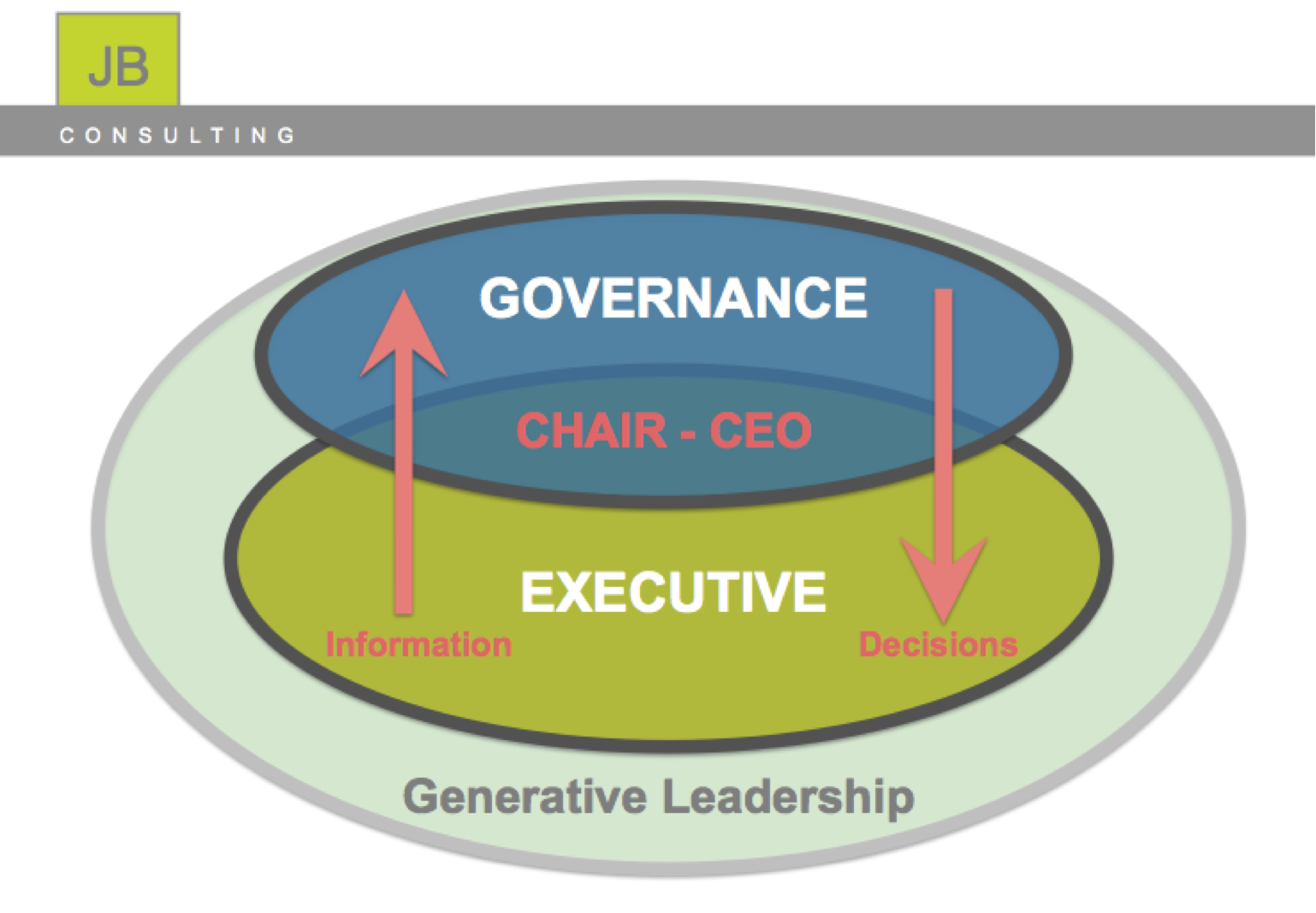
Whatever their particular differences, most of the SRA member organisations share a basic organisational structure. Each structure has 3 primary interlocking systems in common:
.
  • There is an over-arching board of people responsible for Governance and safeguarding the core principles of the organisation. This is led by a Chair who provides inspiration and containment for people’s ideas.
  • Underneath this board is an Executive System of personnel responsible for driving through change on behalf of the board. This is led by the CEO who also provides inspiration and containment.
  • The CEO and Chair connect up these two systems, and mediate the complex boundaries between them.
.
When an organisation functions at its best, there is a flow of information upwards from the executive system, which the Board uses to inform crucial governance decisions about the future of the organisation. Once these decisions have been made, they are implemented downwards through the executive body of the organisation.
.
(Of course the organisations will be significantly more complex if they are member-led, partnerships, or hosted within larger institutions.)
.
.
2. Understand the Innate Tensions That Must Be Managed
.
This 3-system structure carries its own set of  innate tensions which are likely to flare up whenever the organisation comes under pressure:
  • The CEO and Chair interaction can form a bottleneck which obstructs the flow of information upwards flow of decisions downwards.
  • The CEO role can be squeezed from above and below. It can feel very isolated and highly exposed.
  • The Chair and Board can experience the CEO as a barrier to “real” contact with the wider organisation.
  • The CEO and staff can experience the Board as a barrier to efficient and effective decision-making.
  • The CEO “lives and breathes” the organisation 24/7, and can experience the Board as out of touch and removed from operational life.
.
These tensions can lead to anxiety and frustration, and can knock people out of their designated roles. (eg. board members may circumvent the Chair and CEO, and issue management instructions directly to staff. Staff may lobby board members to have the CEO’s decisions overturned. CEOs may engineer the board’s decisions.) These tensions cannot be eradicated, they can only be acknowledged and managed. High performing organisations talk about these tensions; they have the talent to quickly recognise when people are out of role, and will move swiftly to rectify this.
.
.
3. Manage The CEO-Chair Dynamic Relationally Not Technically
.
In this 3-system structure,  a positive and effective CEO-Chair relationship is essential, not optional. It sets the tone for relationships in the rest of the organisation.
.
Although technically speaking the Chair line manages the CEO on behalf of the Board, the relationship cannot be treated just like a classic control-and-command line management arrangement. It has to be handled relationally on a basis of trust and broad consensus.  This is because the CEO has the power to obstruct the implementation of a unilateral decision by the Board. Equally, if the CEO loses the confidence of the Board, the Chair could intervene and micro-manage the organisation.
.
Once a CEO-Chair relationship becomes hostile it is extremely difficult to repair it. And if either party opts to formalise the fight (through disciplinary, grievance, competency or equalities procedures), this becomes an end-game, and one or other party will be forced to leave the organisation.
.
.
4. Practice Generative Leadership
.
It is common for boards to focus on their fiduciary and technical responsibilities: concentrating separately on legal compliance, finances & resources, performance targets, risk management, organisational structure, business planning and strategy. While each ingredient is essential for organisational survival, just focusing on these items alone is dangerous, and focusing on them together is still insufficient for effective leadership in a C21st context.
.
For example, in the current climate of austerity, SRA members face a heady blend of cutbacks, opportunities and radical economic shifts. (The Sport England and public sector budgets have been savaged, which affects funding for civil society organisations. But many SRA agencies could benefit from The Big Society, public health budgets, wellbeing targets, the Olympics, and other international sporting events.) Each of these throws up complex leadership questions, such as:
.
  • How do we provide solid leadership in a very uncertain world?
  • How do we take tough decisions and still keep staff engaged?
  • How do we rapidly gain high level entrepreneurial skills?
  • How do we seize business opportunities and still safeguard our values?
  • How do we adapt to the current government’s policies, whilst shaping a future for our organisation beyond the lifetime of this these policies?
  • How do we form productive partnerships with other organisations – balancing collaboration and competition?
.
In order to do justice to these complex dilemmas, the CEO, Chair and Board need to line up their roles and practice Generative Leadership: understanding how the various fiduciary and technical responsibilities interact with each other, whilst also integrating these with the organisation’s vision and values, and holding a bigger picture of the long term external landscape.
.
.
5. Stay Tuned To The Fundamental Questions
.
The SRA membership represents such a diverse range of organisations and structures that it is impossible to advocate any one-size-fits-all optimum structure for all members agencies. Instead I think there are 5 guiding questions to be mindful of:
  • What structure works best for which type of organisation, under what circumstances?
  • Can we articulate the strengths and weaknesses of our particular structure – then maximise our strengths and mitigate the weaknesses?
  • Are we all clear about each person’s role in the structure?
  • Where we have dual roles, how will we manage our conflicts of interest?
  • How will we evaluate our effectiveness? (What exactly are we evaluating?)
.
.
6. Know When To Compete And When To Collaborate
.
The strength of organisational leaders like those I met at the SRA conference is that they are ambitious and really want to succeed. Their ultimate challenge is to be able to manage their competitive instinct, so that this doesn’t jut become a default position adopted for every working relationship. They have to know when to compete and when to collaborate.
.
So there was a powerful moment in the workshop on building high-level CEO-Chair relations, when one group of CEOs acknowledged:  “We have to want our Chair and Board to succeed in order for us to succeed, and for the organisation to succeed.”
.
How can the CEO and Chair line up and encourage each other to succeed? it needs to be thought of as a ‘coaching’ relationship rather than one of competitors. Together they need to build a shared understanding of the dynamic context in which the organisation operates.  As another group said: “We must hold each other to account, build trust and respect, and act as critical friends.”
.
.

“Building Resilience Through Innovation” – Mind CEOs’ Conference Leads The Way

.
The recent Local Mind Association CEO’s Conference set a great example of how federal organisations can respond to the new funding environment. This has huge leadership implications for CEOs and Boards.
.
.
Earlier this month I was at the Local Mind Association CEOs’ Conference in Birmingham, co-facilitating workshops on “Strengthening the CEO-Board Relationship in Tough Times”.  I came away feeling very inspired by the conference. Paul Farmer, the CEO of Mind, used an impressively open style of chairing in the large plenary sessions, which fostered genuine dialogue with Local Mind Associations (LMAs). There was a convivial atmosphere because many CEOs know and respect each other, and are willing to share their knowledge and expertise.
.
At the same time there was a sombre tone as delegates got down to business: I had some fascinating conversations about The Big Society and the new funding climate, and heard a few CEOs describe their experiences of winning big new contracts at the same time that funding was unexpectedly pulled on other major programmes of work, making complex demands on their leadership.
.
The theme of the conference was “Building Resilience Through Innovation”, and the opening plenary – Critical Issues for the Coming Year – hammered home the tough external environment and the radical pressures that LMAs are facing. Emma Jones, Senior Policy Analyst at The Cabinet Office, gave a very clear presentation, elaborating the 3 pillars of  The Big Society:  Public Service Reform, Social Action, and Community Empowerment.
.
Unfortunately it confirmed my concern that the model of social action and community empowerment  isn’t well suited to people with socially stigmatised and sometimes debilitating conditions like mental health problems. So it seems that the main lever for keeping mental health on the agenda will be via the third Big Society pillar of “Public Service Reform”. This means that the drive for mental health has to come via an organisational service delivery model, rather than via community action. This places a powerful burden of responsibility on networks like Mind to get it right, and to co-create innovative services with their users.
.
Given this demanding context, it was excellent to see Mind and its LMAs squaring up to the challenge – recognising the importance of shaping the commissioning agenda, exploiting opportunities for new funding, and adapting to the new funding climate.  There is a sense of relationships shifting across the Mind federation: greater respect for what each party brings to the table; recognition of the need for both the national and the local perspectives; desire to forge tight working partnerships; and a growing interest in forming consortia to submit block tenders.
.
All this heightens the challenges that will be familiar to federal structures: the need to protect the brand; the need to reconcile collaboration and competition between LMAs; and the need for clear accountability to ensure that each LMA pulls its weight.
.
.
CEO-Trustee Relations Buckle Under Fire
.
So what are the implications of all this change for CEO-Trustee relations? Back in our conference workshops, I conducted a straw poll and discovered that most participants rate their current CEO-Board relationships to be middling-to-good. There were only a few exceptions with lower scores, and some exceptional working relationships rated 10/10. Overall the scores were better than in straw polls that I’ve conducted in other workshops recently. (Though of course none of this is scientific!)
.
Most of the workshop participants were very experienced senior people. They understand how CEOs, chairs and boards need to relate to each other. They are clear about the respective roles and relationships, and they manage to function effectively in role most of the time. However, in the workshops they explained how pressure and stress can knock everyone out of role – When anxiety kicks in, everything kicks off! This tallies with my research into executives who reached a crisis point in their working relations: When under fire, people lose their focus, they lose their sense of competence, they forget what they know, they fall out of role, and then conflict erupts.
.
What I always try to emphasise in workshops, is that my model for lining up CEOs, chairs and boards in their roles and relationships is very simple, but simple isn’t necessarily easy – particularly not when people are stressed.  it is unrealistic to expect CEOs, chairs or board members to be perfectly in role all the time. Rather, they need to learn to recognise when people are out of role – and need to develop the instinct for stepping back into their roles as quickly as possible whilst challenging others to step back into their roles too.
.
.
Fielding The Board
.
When working with charities that have rather “middling” CEO-Board relationships, I often see CEOs investing their efforts in political manoeuvres to “field” their trustees, and hold their boards at arms length. As far as the CEOs see it, they have trustees who are there by default rather than by design, and don’t understand their roles clearly. The CEOs express concern that if members get too close to the operational side they will fence around looking for a purpose, and latch onto the latest hot issue.
.
Again, my research that I summarised in the workshops echoes some of these concerns. It suggests that triggers for CEO-Board conflict arises when people aren’t solid in their roles, and:
.
  • Trustees get swept up in informal staff complaints and rumours about the CEO.
  • Trustees and CEO take difficult decisions together, but when these prove to be unpopular with staff, the board backs out of the decision and drops the CEO in it.
  • Chairs decide on a hunch that the CEO is “incompetent” without following a proper appraisal process.
  • Boards over-react when the CEO makes an error of judgement, and put the CEO through formal disciplinary processes.
  • The CEO and board go head-to-head over the strategic direction of the organisation, and have no mechanism for resolving their strategic differences.
.
So it’s not surprising that those CEOs adopt damage limitation strategies to keep their boards at arms length. It’s understandable, but it’s not a helpful state of play. A positive working relationship between CEO and Board is essential for the effectiveness of the organisation because it connects up the governance and the executive leadership, and models appropriate behaviour for the rest of the organisation.
.
Fortunately there wasn’t much of this in the conference workshops, though I noticed that the widespread use of damage limitation tactics in the voluntary sector flavours participants’ expectations: whereas trustee participants were more inclined to see themselves as a resource for their CEOs, CEOs were less inclined to presume positive support from their boards – they focused more defensively on keeping the trustees’ governance role water-tight.
.
.
Key Leadership Messages for Tough Times
.
With all this in mind, when I was asked to comment on the workshops In the closing plenary of the conference, I brought in two specific themes:
.
Tough times ahead could trigger fiercer fights: LMAs and many other voluntary organisations face immense pressures ahead – and we know that pressures of this magnitude precipitate anxieties and knock people out of role – which leads to intense organisational conflict.
.
So CEOs, Chairs and Boards need to build resilience into their working relations now, and talk about how they will continue to manage themselves in their roles when the going gets tougher.
.
Boards must be a generative resource for their organisations: The conference made it abundantly clear that most of the voluntary sector will have to totally transform the way it does business over the coming years. They need to be more entrepreneurial, explore new markets, consider securing working capital, engage with payment by results, and demonstrate social and economic outcomes. This calls for voluntary sector leaders to develop a very different skill-set from the one that most are accustomed to. And CEOs and Boards will need to develop these together to be sure that they are speaking same language.
.
At the very least those trustee boards that have lacked direction and purpose in the past will have to radically up their game, just to keep up with their CEOs and to be able to govern effectively.  But more than this, the best boards will become a powerful generative resource for their organisations – a body of expertise to guide the organisation in its business, whist still stewarding the charity’s mission, values, and clinical excellence, so that these aren’t sacrificed to short term financial gain.

.

.

How To Handle Those Really Tough Decisions In Your Organisation

.

So you’ve realised the need to take crisis action to bring your organisation back on track. Perhaps you’re having to implement radical changes to terms & conditions, to shake up working practices, or to introduce redundancies. You’re clear about the strategic imperative for this, you know your legal responsibilities, and your mind is fixed on a course of action. But how do you implement such tough decisions and still keep your staff engaged? The solution lies in intellectual and emotional clarity.  This is one of the essential skills of contemporary leadership. It’s difficult to get right, so here’s a structure to steer your interventions.

.

Many clients say that it can be a lonely experience leading these difficult changes.  In the current funding climate a number are feeling sorely tested. (“I didn’t take on this job to dismantle services and implement compulsory redundancies!” “Staff are so angry with me, I dread going into work at the moment.”) These leaders face a really difficult dilemma. For the sake of the survival or their organisations they know they have to act fast to implement tough crisis decisions that will have major negative consequences for their staff. But they also know that they are completely reliant on staff going that extra mile to help bring the organisation back on track. So they have to find a way to engage staff and sustain their goodwill by helping them to understand why these hard decisions are being made.Some clients admit that in the past when they faced tough choices they became detached and hard to avoid the guilty feelings that their decisions stirred up in them. “I wanted to ‘slap’ staff who become angry or distressed – couldn’t they see what a mess we were in?”  Others felt so overwhelmed by their statutory obligations that they became mechanistic (“I followed a tick-box consultation just to cover my butt!”). But these approaches made things even more difficult for the organisation. So leaders actually need to do the opposite: to remain conscious and articulate about the unhappiness that your decisions might cause people, whilst being totally clear about why these decisions are necessary. As one clinical director put it: “You have to feel the pain and do it anyway – as compassionately as possible” …mindful of the fact that it’s awful to have to deliver bad news, but even tougher to be the recipient. 


To do this you have to attend to two parallel issues simultaneously: one is to engage people in the logical rigour of the decision-making process itself; the other is to attend to the emotional impact of the decisions on individuals. If you want people to engage with the logical changes that you are introducing, you have to be in sync with their feelings. And if you want staff to manage their negative reactions to your changes, you have to present a coherent case for for the judgements that you are making.

There are two things that infuriate staff. One is being shut out from the decision-making process. More so if they could have made an important contribution, and believe they would have reached a better quality decision themselves. The other is having their emotional reactions stifled by leaders who put a Pollyanna spin on their unhappiness.  (“I’m afraid your post will be made redundant, but at least that solves your work-life balance, eh?!”) So how do you attend to the decision-making and emotional dimensions of your leadership role? Let’s take each dimension in turn.
.
The Decision-Chain
When presenting a difficult issue to your staff, you may be very clear in your own mind about why your decision is necessary, but it can really help to walk them through a structure such as the 6 elements in the decision chain below. Each element needs to be tested separately in sequence, to ensure that people have really understood the case that you are arguing.


1.) Dilemma – Have we articulated and refined the problem? What is the dilemma that we have to solve? (eg. We are heading for a serious overspend that threatens the solvency of the organisation. We have to balance the budget now.)
.
2.) Data – What are all the relevant facts? Have we captured all the evidence available? (eg. There is no obvious funding to bail us out this year. Staffing costs make up 80% of our operational budget.)
.
3.) Options – What options are available to the organisation? Have we explored all realistic alternatives? (eg. We could merge, share back-office functions, or share our CEO post.)
.
4.) Impact – What are the personal and organisational implications of each option? Do we fully understand the risk in each case? How can we mitigate against negative effects? (eg. What packages of support can we put in place to support staff at risk of redundancy? How can we motivate those staff who remain?)
.
5.) Solution – Have we distilled this information thoroughly? What conclusion have we reached about the best way to resolve our dilemma? (eg. We have no choice but to cut our staff posts by 25%.)
.
6.) Action – What is the course of action for implementing our solution?
.In the pressure of a crisis meeting when tensions are running high, leaders can be thrown off course by the intensity of feeling in staff who are fearful for their jobs. Individual staff may be fired up by different issues in different segments of the decision-chain. One may point out additional options (“We don’t have to cut posts, we could all agree to working fewer hours.”) while another will question the original dilemma  (“We don’t have to balance the budget, we can use up our reserves.”) and another will raise new concerns about the impact (“If we cut posts now we won’t have the capacity to to deliver the services we are contracted to supply. The council will terminate our contract, and that will finish off the organisation.”). It really helps to lead people back through the structure, so that each contribution can be put in context. 

Remember that it isn’t a democratic process, and many staff may not agree with your conclusions, but this is an opportunity to listen to alternative perspectives and be really clear in your own mind about your decisions. The most important thing is that people understand the dilemma that the organisation faces, and get to walk in your shoes – so rather than get yourself boxed into a corner by a barrage of questions from staff, remember to keep asking questions yourself, link these to each stage in the decision chain, and really listen to the answers that staff give.

Many leaders are very familiar with principles of employee engagement, and place great value on staff contributions in business planning and scenario forecasting. But even when staff are kept in the loop, the reality of crisis decisions can still come as a shock. The tougher the decision that has to be taken, the more likely it is to rest on your shoulders as a top-down process without a lot of room for manoeuvre. So it is essential to be clear about what issues are up for debate, and what elements are fixed in stone – staff are infuriated by token consultation on issues that have long been decided. Even in severe consultations there should be scope for staff input into impact assessments and mitigation of negative effects, and in the action planning stages.


.
Emotional Life
.


.
Many people will recognise this diagram – charting people’s emotional reactions to difficult changes – but not everyone fully understands the implications of the curve for change leadership: People experience four different emotional stages when change is thrust upon them:

1.) Shock – in which they feel numb and stunned, and have very limited ability to think clearly.  They might deny the implications of the news, or even weird feelings of euphoria.
.
2.) Emotional turbulence – in which they are consumed by sorrow, anger or guilt. They may have emotional outbursts, or might withdraw and need time on their own to make sense of their feelings.
.
3.) Depression – in which they churn over the implications of the changes, and start to make sense of what is happening. They will feel emotionally flat, demotivated and resigned, and this churning will sap a great deal of emotional energy from them, so it is likely that their productivity will be low.
.
4.) Gradual acceptance – in which they start to re-enage, come to terms with the consequences of the changes, integrate these into their everyday context, and look ahead more optimistically.
.

What are the implications of this for leaders introducing difficult changes? One significant feature is that you are likely to be ahead of your staff on the curve. Chances are you’ve had the shock of realising that you have to take serious action, have run the gamut of upsetting emotions, and are galvanising yourself into action by introducing these decisions. This can make it more difficult to empathise with people who are still in a state of shock, or feeling emotionally wobbly.  People experience the transition curve at different rates, so different staff will be at different stages  – and their progress is never as neat as the diagram suggests, so keep an eye on how people are and adapt your interventions accordingly.

1.) When in shock, people won’t be able to take in much information that you give them, or to grasp the full logic of your decision-chain, so explain the headline features and provide clear written information for when they are in a calmer frame of mind. Acknowledge that people may be in shock, explain the stages that you will be taking for consultation and implementation, and reiterate that there will be future opportunities for discussion. Show that you have considered the impact of your decision by outlining what support you would like to make available. Time your input to minimise disruption to the working day, and to make sure that staff have time to get over the initial shock before they head home. Don’t put a “Pollyanna” spin on things by pretending that the circumstances are good, but do reiterate the positive bottom line that you are after (“If we can implement this redundancy programme now, the organisation will be more robust for the future.”).2.) When in a state of emotional turbulence, people will need help to recognise and name their feelings. Ask them how they are, and what support they need. Articulate your feelings (“I feel really uncomfortable having to break this bad news to you, cause I imagine it must make you feel very frustrated.”)  Walk in their shoes and recognise what they are going through. You are their most likely target for hostile feelings, so be prepared for that, and build in time to debrief afterwards.  Be strong and containing to model that you are capable of holding the organisation together through this difficult period. Carefully acknowledge the emotions you are noticing (“You sound angry with me at the moment, which is understandable given what you’ve just been told.”) and resist the urge to attack back. At the same time, you don’t have to endure abuse, so if any meeting gets out of hand, end it and schedule a follow up event – you need to model the fact that there are limits and that discussions have to be dignified. 

3.) Staff will reach a depressive stage in which they feel they have no choice but to accept the changes, so factor in a period of demotivation when productivity will drop.  It’s easy to be sucked into their sense of hopelessness at this point, which might churn up lots of helpless feelings in you. (“It felt like wading through treacle!”) The instinct is to go into “rescuer” mode and try to find practical solutions to their problems, when in reality these will be rejected because staff are really seeking affirmation for their feelings of resentment. So acknowledge that it is difficult for them, make an effort to understand what people are finding most difficult, and keep asking them to identify what would make their tasks more manageable. Notice those things that individuals are most interested in, and really focus on developing these. As they “churn” they will be incorporating the changes, so this is an opportunity to make some adaptations and to flesh out the practicalities of how to the implement the plan.


4.) As staff gradually accept the changes, the mood will become more positive. This is the time to pick up the pace, become more challenging, and really stretch them with questions about how they see themselves implementing their part in the programme. These are the activities that leaders are most familiar with – that some leaders try to implement prematurely, at the point when staff are still in shock and not ready to engage. If you can hold fire until staff are showing signs of acceptance, you stand greater chance of succeeding.  Again, remember to acknowledge the fact that staff are more positive, and be appreciative of their progress.
.

When people are confronted by painful scenarios it tends to trigger “paranoid” anxieties, so it’s essential to emphasise the values and principles underpinning your decisions, and to act with integrity throughout. Keep the overall focus of your decisions on your organisational mission and your service users, but focus your implementation on the needs of your staff – give them permission to look after themselves, and help them to direct their energies at what they can control. Encourage them to have a “Plan B” in mind for their worst case scenarios – so that they can set aside these anxieties for the time being. (“We’ve done everything we can for now, and we’re not going to let ourselves worry about it unless it becomes a reality.”). The bottom line with difficult change is that feelings need to be understood, named and appreciated rather than bottled up. It’s once these can be fully acknowledged that your staff will begin to reconnect with their creativity and passion for the organisation.
.
.

The Big Society Needs You! 5 Tactical Steps For Voluntary Organisations

The Big Society cannot succeed without the voluntary sector – and that’s a huge advantage in the long run for voluntary agencies. Here are 5 tactical steps for any voluntary organisation that is feeling the squeeze at the moment.


The public spending review will create a harsh climate for many voluntary organizations in the next few years. But if they can survive this period of austerity, there will be unexpected opportunities ahead from The Big Society. This is because The Big Society will see some early wins, but ultimately the limitations of the model, and the hardships caused by the spending review, will begin to bite.

Politically The Big Society cannot be seen to fail, so this is the point where voluntary agencies will be in a better position to negotiate contracts to plug some of the serious gaps in statutory service provision – and to turn The Big Society into a viable project.

So one survival tactic for voluntary agencies hit by the current spending review is to develop a sophisticated critique of what will and what won’t work within The Big Society framework. To then embrace The Big Society rhetoric and apply it to service delivery where this is possible; and, where this isn’t possible, to develop specific services that correct Big Society flaws.

These voluntary organisations need to consolidate rapidly now to absorb any immediate funding cuts and avoid insolvency – but without just resorting to a slash-and-burn strategy. There are 5 particularly tough challenges ahead that have to be factored into this consolidation:

(1) To retain leadership capacity at the top of the organisation – and redefine the leadership role. Voluntary organisations need entrepreneurial talent at the top to reposition the organisation to pick up on future funding opportunities. Leaders must have emotional literacy to engage and motivate stakeholders throughout these anxiety-provoking changes. The Chief Executive and Chair (and trustee board) need to be closely aligned – they need complex strategic planning expertise, sophisticated financial modelling, and a shared understanding of how change happens effectively.

(2) To design an organisational structure that can be stripped down to its core to ride out the cuts – but with the capacity to expand in the future when new financial opportunities present themselves. This structure needs to serve as a hub onto which you “dock” additional teams when new service contracts are won. The workforce needs a mix of freelance, permanent, and time-limited staff working in flexible roles. There needs to be a well-considered involvement of volunteers and service users in the structure. Everyone involved will need resilient personalities to adapt to changing demands.

(3) To rethink the organisation’s service delivery model to ensure that it is sustainable. To go back to the organisation’s core purpose and core values, and then consider whether there are leaner ways to meet the needs of service users. Some services and service users do fit the Big Society model of volunteerism and self-help – so some of these services that are currently provided by paid staff could be delivered safely by a blend of service users, volunteers and community groups. This is an excellent way to free up staff to do the high-level tasks that they are best suited to do. But remember that this model changes the relationship between the organisation and its volunteers and service users to something more ‘professional’ – they will make bigger demands of you, and vice versa – and they need high quality, supportive supervision to ensure a consistent standard of delivery. Who will provide this time-intensive development? Here is a powerful presentation by Sam Hopley to trigger some ideas.

(4) To identify the cracks in The Big Society framework, and spot the service gaps arising from the spending review – then seek out new service opportunities there. Local authorities have statutory duties that could be hard to sustain in the chaos of restructuring and cuts, and there are many marginalised community groups that don’t sit easily within The Big Society model – either through stigma, or through not having the resources, knowledge, expertise or resilience for self-help (eg. chaotic drug users, ex-offenders, people with enduring mental illness or learning disabilities, long-term homeless, street sex-workers, and refugees). Voluntary agencies need to put the case for why these services are essential, and why they are best suited to deliver them in the most cost-effective and accessible manner. This requires slick expertise in full cost recovery, social return on investment, evidence-based service development, and outcomes evaluation.

(5) To monitor the real impact on people’s lives of the government’s sweeping reforms. The abolition of government targets will make it much harder to track the negative impact of the cuts on service delivery. It will also make it harder to assess the disruption caused by the major restructuring of the public sector. The localisation agenda will make it that much harder to connect up data and spot the over-arching trends. Voluntary agencies will be the closest witnesses to the hardships caused by service cuts. They can draw on this painful first-hand experience to spell out the negative social consequences of not providing services – and use it as a lever to secure funding to provide decent services where they are most needed. This information needs to be pooled to establish a nationwide picture of the human cost behind the programme for economic recovery – so it’s worth getting involved with NCVO’s debate.
.
.

The Voluntary Sector – A Lifeline For The Big Society?

.

The Big Society model is flawed – but it presents unexpected opportunities for voluntary organisations in the coming years.


Many voluntary sector organisations have reacted to the prime minister’s proposals for The Big Society with scepticism. To many, the fact that it is being championed concurrently with radical austerity measures suggests that The Big Society is just a cynical ploy to get communities to pick up the pieces after public and voluntary sector services have been decimated.

Voluntary and community groups are right to be concerned about the spending review: they will bear a huge brunt of the cuts to public spending. Those agencies that survive the funding cuts will be most exposed to the harsh impact that the service cuts have on their clients. They will be under immense pressure to find some means of providing support to more service users on a far smaller budget than before.

That said, I don’t think that The Big Society is just a cynical ploy to lumber communities with the state’s social burden. I believe that The Big Society genuinely wants to champion civil society, and that it will be effective for mobilising some social action – but only within a limited range of possibilities.

.

Big Opportunities

At its heart The Big Society seems to be a self-help movement. It wants to remove obstructive local bureaucracy so as to empower local people to take over failing services. It wants to give control back to communities so they can help themselves.

This could work well for people with strong leadership and social skills, with spare time to allocate, and with the vested interest to unite and tackle a particularly urgent problem that affects them personally. The example that is regularly put forward is of parents whose children are at a failing school taking over the running of the service. Parents would have an immediate vested interest in rallying together to sort out the crisis.

.

Big Limits

But there are limitations to the Big Society model. My clients in the education sector will tell you that it takes years to transform a failing school. It is hard to imagine many parents’ groups sustaining intensive input into a school’s development whilst also holding down their other career commitments.

What is under-played is the fact that any take-over (such as parents taking over the running of a school) is a bloody and messy affair with blame and counter-blame, withholding of essential operational data, and complex legal wrangles. Today’s rescuing heroes quickly become demonised as tomorrow’s villains as soon as anything goes wrong. Groups who take over the running of public services will require a hugely sophisticated understanding of conflict resolution to be able to succeed.

So TBS might actually have the unintended consequence of helping citizens to appreciate quite how complex and thankless a job it is to manage public services. People might well rescue a failing service and then discover what a nightmare they have taken on. The are likely to want to parcel it up quickly and to hand it over to another managing body with the sustainable infrastructure to govern it effectively. This is where entrepreneurial voluntary organisations could come in.

And imagine how The Big Society movement would handle a different scenario : a neighbourhood experiencing major problems with chaotic drug use. The community might come together to reduce the impact of the problem via projects for public safety, removing used syringes quickly, and making it difficult for dealers to operate locally. Brilliant if the neighbourhood is given the resources to make this happen – but their intervention won’t tackle the complex social causes of illicit drug use, it just moves the problem on to a less resilient community.

It will take specialist voluntary groups to help local communities to understand that their longer term interests are best served by adopting more integrated solutions that include harm minimisation, rehabilitation, and anti-poverty programmes.

.

Identifying The Shortfall

At some point in the next two years or more the successes and limitations of The Big Society will become more apparent. The impact of the spending review will be known, the chaos of public sector restructuring will be bedding down, gaps in statutory provision will be more visible, and the “blind spots” of GP commissioning will show. The government can’t allow The Big Society project to fail, so at this stage it will be pressed to do something about the shortcomings. It will have to consider:

  • Strategic development, prioritising of resources, and evidence-based approaches to service delivery.
  • Bridging the planning gap between central government and local areas (given that regional bodies are being abolished).
  • Reconciling the competing needs of different communities in local areas.
  • Service provision for constituencies that aren’t well served by the Big Society model, such as stigmatised user groups (like injecting drug users, ex-offenders) or  user groups where co-production is more complex (people with enduring mental illness or learning disabilities).
  • Capacity building, engagement with marginalised communities, and redressing social inequalities.

.

The Voluntary Sector Could Offer Solutions

Much of this work could be picked up by voluntary and community organisations if they position themselves well and offer low cost solutions. The public sector won’t be able to deliver these solutions, as it will have to concentrate on high-level strategic planning, and will no longer have the capacity for new service delivery. The private sector will have to concentrate on large-scale capital-funded contracts – it won’t be able to compete against the voluntary sector on price and generally lacks the right ethos for community interventions.

So there will be new opportunities for voluntary organisations in the years ahead – that’s if they can survive the current financial hardships and align themselves with Big Society thinking. The challenge will be to scale back now to ride out the cuts, whilst still retaining the capacity to expand in the future when new opportunities present themselves. In the meanwhile voluntary agencies need to do some intensive work to identify what unique contribution they could make to turning The Big Society into a viable project.

.

.

Forging Partnerships Across The Fault Lines

Partnerships may be the key to realising The Big Society but they need sophisticated handling to work effectively across the fault-lines. Effective partners engage tactically not idealistically.


Partnership working is being heralded as The BIG ANSWER to The Big Society, Localisation, and on a tumultuous public spending review. What’s not to like? It is true, partnerships will be an essential lever of The Big Society, but not in the idealised form that politicians would have us believe. Partnerships have innate adversarial tensions built into their relationships, and these can only be worked with – they cannot be eradicated.

To make the most of partnerships, the partnership leaders need to manage these tensions – as far as possible lining up member organisations behind a vision of what the partnership might be, whilst helping members to work with the frustrations and contradictions where it falls short of these aspirations. Equally, participant organisations need to understand that partnerships are a shifting coalition of interests, complex and messy, with unpredictable consequences. Partners need to engage tactically not idealistically, mindful of the pressures on other member bodies, engaging in satisfying alliances for a finite time within the current constraints, where they can see a clear advantage.

I guess the current ConLibDem Coalition Government is a perfect example of this  – The Cameron-Clegg pairing is an arranged marriage with possibilities and potential and risks and dangers. How can they make the most of what has been thrust upon them? If they misunderstand what is possible and presume to be in love, they will burn up their energy by flirting, seducing, squabbling and divorcing – missing the opportunity to have a significant workable relationship! That partnership will last (only) as long as each party can co-opt the opposition and has sufficient goodwill to involve each other in co-creating solutions. It will break up when the partners run out of goodwill or when their differences overwhelm their commonality.

.

Learning From Local Strategic Partnerships

Although partnerships take many forms, I think the experience of Local Strategic Partnerships provides a particularly rich picture of the fault-lines that cut across effective working. Tensions emerge most clearly after Government spending allocations, and Council or PCT tendering rounds. These tend to bring into sharp relief the painful reality that there isn’t economic parity between members of partnerships, and partnerships are ultimately not democratic. Here are a few examples:

  • Although they don’t participate directly in partnerships, Central Government departments can have major impacts on these groups. They tend to grapple with espoused values of localisation vs their need to influence what happens regionally or risk getting slated in the tabloids or getting it in the neck from the electorate. Their main official tools of control are blunt instruments: funding, targets and inspections.
  • Central Government sometimes makes partnerships a criterion for funding local statutory bodies – thus confusing process (ie. “create a partnership”) with intended outcomes (eg. “reduce violent crime by 10%”). These statutory bodies rush to create partnerships in order to meet funding criteria, and the groups then struggle with disingenuous motives and unclear outcomes.
  • Local Statutory Bodies (PCTs, local councils) wrestle with the tension between democratising their decision-making, whilst feeling burdened by their safety liabilities, procurement legislation, and accountability to central government. They give out confusing messages to partnership members about their sphere of influence.
  • Government Departments can find themselves concerned to leverage positive results more quickly (eg. In time for elections), and allocate new funding that has to be spent rapidly on high profile initiatives. Local statutory bodies then struggle with the tension between taking rapid autocratic decisions to allocate funding within the timescale, vs losing out on the funding.
  • Local Statutory Organisations do not behave as unitary entities – different parts of each organisation pull in different directions and take contradictory decisions. (eg. Adult Services increases funding to a carers’ charity while Central Services evicts the charity from the council’s low-rental premises.) Individual members of staff representing these statutory organisations get it in the neck from partner organisations and can feel very put-upon.
  • Smaller Provider / Community Organisations wrestle with the tension between maintaining a presence in cumbersome LSP meeting structures where the sources of funding are, whilst trying to find capacity to deliver essential services in the community.
  • Smaller organisations feel compelled to tender for service contracts in order to earn income to survive, which can distort their original service mission and values.
  • Central and Local Government struggle to consult directly with service users without the mediation of local community groups. They both believe that they have the mandate of their electorate.
  • Local Community Organisations fire fight daily to resolve the crises of their users. They believe they have the mandate of the disenfranchised, and that they represent the “true” voice of service users.
  • If the partnership focuses on the details of the personal experiences of individual service users, then senior Statutory members disengage, stop attending, and the Partnership loses its “bite”. If the partnership focuses on very corporate matters, then local Community Groups and Service Users become alienated and the Partnership loses it’s “user-credibility”.

Future partnerships may take different forms, and may have different fault lines, but the underlying theme remains:

For a partnership to be effective, larger participant organisations have to manage the tensions between commissioning and providing services, and service agencies need to strike a balance between collaboration and competition. The successful players in a partnership are the organisations that recognise these dynamics and decide to engage tactically – rather than those that attempt to be idealistic and all-encompassing.

The successful partnership is able to see the relationships for what they are, rather than believing the espoused rhetoric of democracy. If these tensions are not managed effectively, conflict erupts, all institutions retreat, and everybody loses out – especially service users.

If the partnership can acknowledge the contradictions, and work with them in a measured and contained way, greater trust will evolve over time. Decision making processes will gradually become more consultative if partners demonstrate mutual understanding and learn together.

.

.

Gearing The Top Team for Tough Times

In the current climate of severe cuts to the UK’s public and voluntary sector, it is essential that your top team is geared up for the challenges ahead. This means building the team even when time and finances are stretched.

In the wake of the Chancellor’s emergency budget, many of my clients are gearing up for tough times ahead.  A few organisations are already in the thick of it – having to introduce emergency budgets in response to early funding cuts from public bodies – and others know it’s only a matter of time before this is a reality.

The big tension with budget cuts, is that the financial benefit comes from being able to implement savings rapidly in-year, whereas the recovery depends on how thoughtfully the process is handled – in the decisions about what to cut, the way in which the impact on individuals is handled, and the way in which organisations are reconfigured. If you can balance this tension and do both well, it will make a huge difference to your organisation’s future.

The sudden reality bite of the emergency budget has cast a spotlight the state of top teams. Not all executive teams are geared up to handle the immense demands that will be made on them in the coming months. Team members will have to work together like never before: to take tough cost-cutting decisions; to generate lean service innovations; to steer unpopular changes; to handle upsetting redundancies – including redundancies in their own teams; and to hold the organization on track throughout.

Up to now, most senior teams have managed a sufficient degree of give-and-take cooperation to get the job done. Their decision-making didn’t call for highly sophisticated engagement. But the quality of interaction that enabled them to get by in good times does not equip them sufficiently for the tough choices that they will have to make. It will now require a robust and sophisticated degree of sharing and openness to handle the complex demands that are about to be placed on them.

There is another paradox here – When teams most need to up their game, they are least able to learn how to do so. Under pressure team members find it exceptionally difficult to trust and to be open with each other, because a state of high stress tends to generate anxiety and suspicion. So at the time when teams most need to pull together to work on complex problems, they are least inclined to act in a unified way. And stress also inhibits team learning, so if members haven’t already learnt how to function as a high performing team, they will struggle to learn to collaborate effectively under pressure.

This means that leaders need to line up their executive teams now before the pressure really kicks in. This requires a substantial investment of time, effort and resources – and sophisticated PR to explain your decision to adopt development activities when all around you expect to see frenetic fire-fighting behaviour and a climate of austerity! Conventional wisdom dictates that it is wrong to invest scarce resources in executive team development at a time when jobs might be on the line, but remember that a slash-and-burn policy could destroy your organisation.

One CEO client has put her neck on the line: in anticipation of cuts of around 20% across the board, she embarked on a development programme to fine-tune her top team, much of it looking ahead at how they will take tough decisions and how they will keep staff engaged. She made a guarantee to staff that they will experience a positive difference to the way in which the forthcoming programme of cutbacks and the organisational recovery will be handled.  The fact that staff and trustees now have this expectation creates an added incentive for her executives to pull together and make the most of these development opportunities.

Key Action Points For Leaders:

  • Get cracking with teambuilding now, and get everything in place so that the team operates at optimum level before the toughest work has to begin.
  • Challenge your executive to deliver, and focus on the recovery not just the cuts. Reinforce key messages about rigorous decisions, treating all staff with dignity, and the importance of refocusing on top priorities.
  • Manage the PR dimension with your staff: investing in your top team is essential, and staff will experience a positive difference in the way these changes are handled. (Make sure you invest in your middle teams too – they will be handling change at the coal face.)
  • Understand that teambuilding isn’t something detached from the primary organisational task. Use the impending changes as a focus for your team development – build the team around the programme of change.
  • Aspects of the team development will require external facilitation, so get help where you need it. On a tight budget, target external input to those essential points where it is most effective. Good consultants can help you think through what interventions are most effective, and where best to invest their energy.
  • Understand that this places huge demands on you as leader to nurture and reinforce high-level cooperation in your top team. Make sure you are supported too.

Inspiring reading: David Casey, When Is A Team Not A Team? in Personnel Management, January 1985